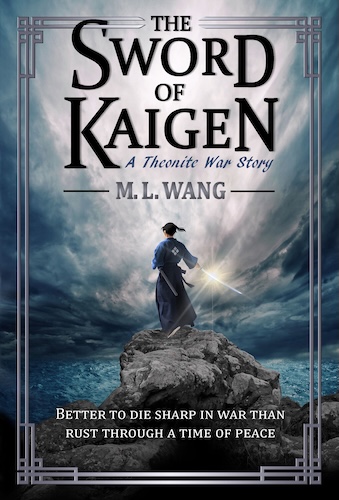
Misaki, a mother hiding a violent past, Takeru, her cold and distant warrior husband, and Mamoru, her teenage son and prodigy warrior, are forced to band together to fend off an invasion. The story takes place in a fantasy world that, at first, appears to be based on feudal Japan, but is actually set in a more modern time frame (with phones, airplanes, and other technology), mixed with fantasy powers where warriors fight by manipulating the elements (e.g., some warriors can manipulate water to create spears and shields, others can manipulate air to soar through the sky, and so on). This creates a unique world that mixes fantasy powers, feudal customs, and military action into something fun, beautiful, and powerful.
One thing this story does well is character growth. Although the characters start off feeling like tropes from Japanese fantasy stories—the subservient housewife, the brutal warrior husband, the obedient son who wants his dad to be proud of him—they all turn out to have fascinating character arcs, with much more depth than I was expecting. It’s impressive how almost every character is considerably different at the end of the story than where they started.
I also enjoyed the elemental powers in the book. They are used to great effect in the battle scenes, with lots of creativity employed in how you can use water or air or fire to your advantage. It reminded me of the Mistborn Saga, both in how well the action scenes were written, and in the fun and unexpected ways a small number of basic magical abilities can be combined to do something badass.
The setting is heavily inspired by feudal Japan: the warrior houses with Samurai-like warriors, strict patriarchal structure, codes of honor, god-like emperor, obedience to authority, character and location names, and so on. However, the modern world starts to encroach upon this setting, with its technology and new ways of doing things displacing ancient traditions. Add to that a deep, dark secret that the empire is hiding, and you get a powerful set of conflicts that drive the story forward.
Overall, it was a very fun read. I always found myself looking forward to picking up the book. The only drawback is that this isn’t a series! Although the subtitle of this book is “A Theonite War Story,” and M.L Wang has written some other books that use the term “Theonite,” those books are largely unrelated to this one, and Wang has officially said that the Theonite series is discontinued. A damn shame, as I would’ve happily read many more books set in this world.