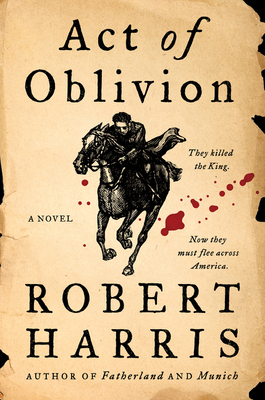
In 1660s England, Edward Whalley and his son-in law William Goffe secretly board a ship headed to the New World. They are men wanted for murder. And not just any murder, but the murder of the King of England, Charles I. Richard Nayler, secretary of the regicide committee, is tasked with tracking down these regicides, and bringing them to justice. Based on real historical events, it makes for an interesting read of a high-profile 17th century manhunt.
Before reading this book, I didn’t know anything about this period of history. For those as ignorant of this period as me, here’s a summary of what I understood:
- There was a Civil War in England from 1642-1651. Some of the underlying causes were that King Charles I tried to rule without parliament, raise taxes, and take the Church of England back towards Catholicism.
- Oliver Cromwell led the parliamentarians in a rebellion against King Charles I and the royalists. The parliamentarians defeated the king’s army, captured the king, tried him for treason, and found him guilty. 59 men ended up signing the death warrant for Charles I, who was then executed.
- The monarchy was abolished, and England was declared a republic. However, before long, Cromwell declared himself Lord Protector for life, and abolished the parliament. He also led brutal conquests in Ireland and Scotland, forcibly putting everyone under the rule of the republic.
- When Cromwell died in 1658, the royalists resurged, bringing back the monarchy, and crowning Charles II as king. Charles II passed the Indemnity and Oblivion Act, granting a blanket pardon to all parliamentarians (to avoid another civil war). However, there was one exception: the 59 men who signed the death warrant, and all the court officials and executioners involved with the trial, were declared traitors, and an order was put out to arrest them.
This book follows two of these men, Whalley and Goffe, as they flee from England. And they had very good reason to flee: if caught, they would be publicly hanged, drawn, and quartered. The story follows these two men as they try to evade capture in New England, traveling through Boston, Cambridge, New Haven, and so on. These are all cities I’ve been to, so I found it interesting to read about what they looked like in the 17th century: small towns, deeply religious people, English rule (begrudgingly accepted, and sometimes resisted), a strong Native American presence, and so on.
The manhunt is initially exciting, but the story spans many years, and in parts, it gets a bit slow. That said, it’s during those slow parts that we get to hear Whalley’s reflections on the Civil War. As Cromwell’s first cousin, and a General in Cromwell’s army, Whalley played a major part in the Civil War, and it was fascinating to see his thoughts on what happened, what he regretted, and whether it was worth it.
Overall, a book that’s fun and educational, a bit slow at times, and ultimately well-worth reading.