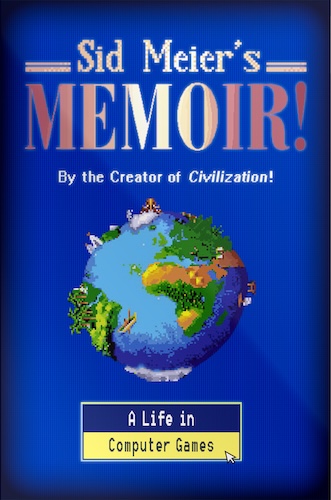
This is the memoir of Sid Meier, co-founder of MicroProse, and creator of some of the most popular and influential video games of all time, including Civilization, Pirates!, and Railroad Tycoon. The Civilization series is one of my all-time favorite game series—I cannot count how many times I’ve said, “OK, just one more turn, and then bed,” only to look up, and realize the sun is rising—so I found this book to be an entertaining and informative read on how some of these games were created.
Here are a few of my favorite takeaways from the book:
1 billion minutes
As of 2020, when this book was published, Steam reports that players have spent more than 1 billion minutes playing Civilization 5. If one person played non-stop, that’s nearly 2,000 years of play time. And that’s just for one of the dozen or so civilization games and expansions, on one platform. Insane. I wonder how many of those minutes are my own…
No overnight successes
Sid Meier is best know for the game Civilization, and to many, it seemed like that game became a mega-hit out of nowhere. However, the reality is that by the time Civilization came out in 1990, Sid had been making games for nearly a decade, and Civilization was roughly the 27th game he had created. It made me think of the 10,000-hour rule from Outliers.
Games are a series of interesting decisions
Sid Meier has famously said that “a game is a series of interesting decisions.” In this book, he adds a bit more detail to that idea:
Interesting decisions are not about the specifics of what you let the player choose between, but whether the investment feels both personal and significant to the outcome… Ultimately, the most fundamental characteristic of an interesting decision is that it makes the player think, ‘I wonder what would happen next time, if I did it differently?’
A game is not just a vehicle for fun, but an exercise in self-determination and confidence. Good games teach us there are tradeoffs to everything, actions lead to outcomes, and the chance to try again is almost always out there.
Games are about the player, not the game designer
Other works of art are successful when the performer is interesting, but a game is successful only when the player is interesting. Our job is to impress you with yourself.
Feedback is fact and player irrationality
Meier believes that “feedback is fact”. If a player feels a mechanic is unfair, then it makes the game less fun, and it doesn’t matter if that mechanic is realistic, or logical, or is implemented correctly from a mathematical standpoint. This is especially visible with how irrational players are about probabilities:
- The 3:1 rule. For most people, if you have a 3:1 advantage in a battle, you believe that victory is guaranteed. In reality, a 3:1 advantage gives you a 75% chance of winning, which means you should lose 25% of the time, but if you implement that in the game, players will feel the game is unfair or broken. So many of Sid Meier’s games are hard-coded to give you a guaranteed win any time the odds are 3:1 or better. It’s not mathematically correct, but it tends to make the game feel more fun.
- Bad luck mitigation. If your odds are 1:1 in a battle, you aren’t surprised when you lose half the time. But if you fight 3 battles in a row, you will lose all 3 battles about 12.5% of the time. For many players, if this happens, the game again feels unfair or broken. Therefore, Sid Meier’s games keep track of losing streaks, and artificially boost your odds if you have several losses in a row.
- Big vs small numbers. If you have a unit of strength 2 go up against a unit of strength 1, you probably aren’t surprised that you lose from time to time, as 2 is pretty close to 1. However, if you use a unit of strength 20 against a unit of strength 10, you may be surprised that you lose just as often as in the 2:1 battles (as the odds are identical); after all, the difference of 10 feels so much bigger! This is another place where Sid Meier’s games either artificially change the odds to make the game feel more fun, or move away from simple odds calculations to other mechanics, such as health bars and multi-step battles.
This manipulation of probabilities has been copied by many other games, such as X-Com.
Iteration over up-front design
I found it interesting that Sid Meier and his companies did not create design docs for their games:
This is why I never write design documents. Some managers are irrationally devoted to them, expecting to see the entire game laid out in descriptive text and PowerPoint slides before a single line of code is ever written. But to me, that’s like drawing a map before you’ve visited the terrain.
Instead, they would just build prototypes, test them, keep what worked, and delete what wasn’t working. Sid Meier even had a rule, where if he was tweaking something, he would always either halve it or double it, as that gets you to the right value much faster than going up or down by just 5%.
Leaders in Civilization
The game includes a number of historical civilizations, such as the Romans, Egyptians, and French, and each one is led by a famous leader from that civilization, such as Caesar, Ramesses, and Napoleon. They ran into a problem with Germany: their most famous leader is Hitler, but they were worried about the backlash from the community. Eventually, they settled on Frederick the Great. Interestingly enough, at the time, they were not worried about backlash from having Stalin as the leader of Russia and Mao as the leader of China.
The Gandhi bug
There’s a famous story that, due to an overflow bug, the most peaceful leader in the game, Gandhi, would become the most violent, and inevitably, you’d get nuked by Gandhi. It turns out that this was an urban legend, and no such bug existed or was possible in the game!
Marketing and sales
I got a chuckle from the story of how Sid’s co-founder, Bill Stealey, did marketing and sales for MicroProse games. Over a period of a few weeks, he would call game stores dozens of times, doing different voices each time, asking if they carried the latest MicroProse game, and acting upset if the answer was no. Then, a short while later, he’d call again, but this time introduce himself on behalf of MicroProse, and ask the store owner if they were interested in ordering the game. Not surprisingly, the answer was often yes, thanks to all the “demand” Bill drummed up himself.