
A guide to understanding how cultural differences affect the way people communicate. The book looks at 8 dimensions (e.g., direct vs indirect negative feedback, egalitarian vs hierarchical leadership, consensual vs top-down decision making), and by understanding where your culture falls on each spectrum relative to others, you can collaborate more effectively. Although pitched as a business book, it’s really a fascinating look into the different way people think and act, and is worth reading for anyone who interacts with other cultures.
Here are my detailed notes from the book:
The 8 dimensions
- Communicating: low vs high context
- Evaluating: direct vs indirect negative feedback
- Persuading: principles vs applications first
- Leading: egalitarian vs hierarchical
- Deciding: consensual vs top-down
- Trusting: task vs relationship based
- Disagreeing: confrontational vs avoids confrontation
- Scheduling: linear vs flexible time
Let’s dive into each of these in the next 8 sections.
1. Communicating
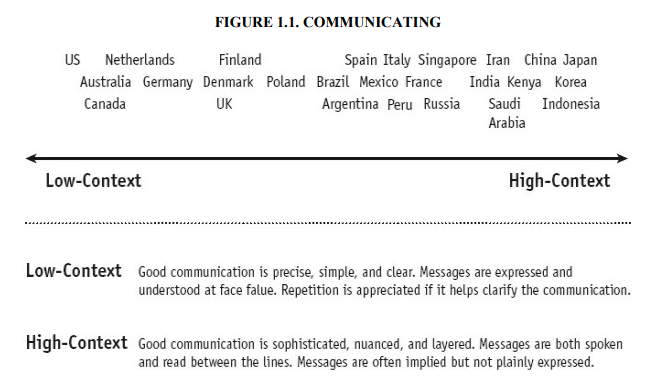
High-context cultures, such as Japan, have a lot of shared context: that is, shared reference points, common assumptions, and implicit meanings. In these cultures, communication is more nuanced and layered, with a lot of the meaning implied, but not directly stated. In low-context cultures, such as the US, there is little shared context between people, so communication is explicit, simple, and clear.
Here’s a great example from the book:
Pablo Díaz, a Spanish executive who worked in China for a Chinese textile company for fifteen years, remarked, “In China, the message up front is not necessarily the real message. My Chinese colleagues would drop hints, and I wouldn’t pick them up. Later, when thinking it over, I would realize I had missed something important.” Díaz recounts a discussion he had with a Chinese employee which went something like this:
- MR. DÍAZ: It looks like some of us are going to have to be here on Sunday to host the client visit.
- MR. CHEN: I see.
- MR. DÍAZ: Can you join us on Sunday?
- MR. CHEN: Yes, I think so.
- MR. DÍAZ: That would be a great help.
- MR. CHEN: Yes, Sunday is an important day.
- MR. DÍAZ: In what way?
- MR. CHEN: It’s my daughter’s birthday.
- MR. DÍAZ: How nice. I hope you all enjoy it.
- MR. CHEN: Thank you. I appreciate your understanding.
Díaz laughs about the situation now. “I was quite certain he had said he was coming,” Díaz says. “And Mr. Chen was quite certain he had communicated that he absolutely could not come because he was going to be celebrating his daughter’s birthday with his family.”
Here’s another wonderful example:
For example, let’s say that you and a business colleague named Maryam both come from a high-context culture like Iran. Imagine that Maryam has traveled to your home for a visit and arrived via a late-evening train at 10:00 p.m. If you ask Maryam whether she would like to eat something before going to bed, when Maryam responds with a polite “No, thank you,” your response will be to ask her two more times. Only if she responds “No, thank you” three times will you accept “No” as her real answer.
The explanation lies in shared assumptions that every polite Iranian understands. Both you and Maryam know that a well-mannered person will not accept food the first time it is offered, no matter how hungry she may be. Thus, if you don’t ask her a second or third time, Maryam may go to bed suffering from hunger pains, while you feel sorry that she hasn’t tasted the chicken salad you’d prepared especially for her.
In a high-context culture like Iran, it’s not necessary—indeed, it’s often inappropriate—to spell out certain messages too explicitly. If Maryam replied to your first offer of food, “Yes, please serve me a big portion of whatever you have, because I am dying of hunger!” this response would be considered inelegant and perhaps quite rude. Fortunately, shared assumptions learned from childhood make such bluntness unnecessary. You and Maryam both know that “No, thank you” likely means, “Please ask me again because I am famished.”
Mixing low- and high-context cultures can lead to vastly different perceptions:
If you’re from a low-context culture, you may perceive a high-context communicator as secretive, lacking transparency, or unable to communicate effectively. Lou Edmondson, an American vice president for sales at Kraft who travels around the world negotiating deals with suppliers in Asia and Eastern Europe, put it starkly: “I have always believed that people say what they mean and mean what they say—and if they don’t, well, then, they are lying.”
On the other hand, if you’re from a high-context culture, you might perceive a low-context communicator as inappropriately stating the obvious (“You didn’t have to say it! We all understood!”), or even as condescending and patronizing (“You talk to us like we are children!”).
2. Evaluating
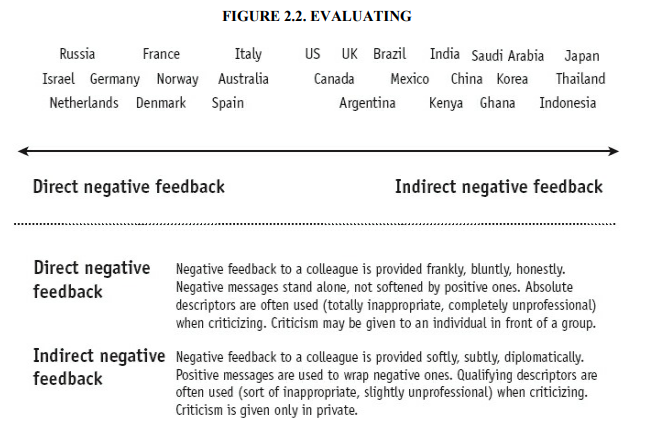
Some cultures, such as Japan, give negative feedback in an indirect way: they will state things subtly, kindly, perhaps wrapped with positive feedback, and will only give negative feedback in private. Other cultures, such as Israel, give negative feedback much more directly and bluntly, focusing on the negative much more than the positive, and regularly giving negative feedback in public.
One way to spot this is to note the use of upgraders or downgraders:
More direct cultures tend to use what linguists call upgraders, words preceding or following negative feedback that make it feel stronger, such as absolutely, totally, or strongly: “This is absolutely inappropriate,” or “This is totally unprofessional.”
By contrast, more indirect cultures use more downgraders, words that soften the criticism, such as kind of, sort of, a little, a bit, maybe, and slightly. Another type of downgrader is a deliberate understatement, a sentence that describes a feeling the speaker experiences strongly in terms that moderate the emotion—for example, saying “We are not quite there yet” when you really mean “This is nowhere close to complete,” or “This is just my opinion” when you really mean “Anyone who considers this issue will immediately agree.”
3. Persuading
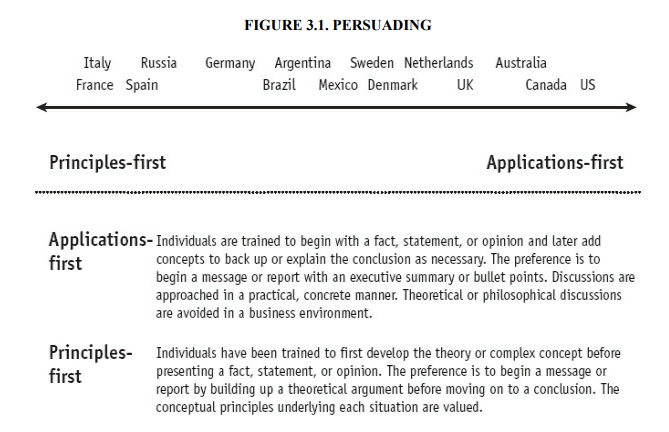
Some cultures, such as France, prefer principles-first reasoning, where you start with the general principles and theory, and build up from there to the practical applications in the real world. Other cultures, such as the US, prefer applications-first reasoning, where you start with the practical applications, and then show the data and perhaps theory that led to those conclusions.
Here’s an example from the book:
I felt the full force of the applications-first method when I studied Russian in my American high school. We walked into Mr. Tarasov’s class on the first day of school, and he immediately fired questions at us in Russian. We didn’t understand a thing. But gradually we started to understand, and, after a few lessons, we began to speak, putting words together any which way we could. Then, with Mr. Tarasov’s guidance, we began using sentences whose structure we did not understand to create a conceptual grammatical framework.
By contrast, in a principles-first language class, learning starts with understanding the grammatical principles underpinning the language structure. Once you have a solid initial grasp of the grammar and vocabulary, you begin to practice using the language. This is the way my husband learned English in his French school, and ironically, his knowledge of English grammar is far superior to that of many Americans. The disadvantage is that students spend less time practicing the language, which may mean they write it better than they speak it.
In a business context, if you’re dealing with an applications-first culture, you should get to the point (your conclusions and their implications) immediately, whereas if you’re dealing with a principles-first culture, you should first provide all the background information and theory, and then derive your conclusions from that.
Applications-first thinkers like to receive practical examples up front; they will extract learning from these examples. In the same vein, applications-first learners are used to the “case method,” whereby they first read a case study describing a real-life story about a business problem and its solution, and then induce general lessons from it.
Principles-first thinkers also like practical examples, but they prefer to understand the basis of the framework before they move to the application. And for anyone raised in a principles-first culture, the American case method may seem downright odd. One Spanish executive told me, “In Spain, we have had it drilled into us since we were young that every situation is different and you can’t assume that what happens in one situation will happen in another. So, when we are supposed to review the situation of one specific protagonist and extract general learning points, it may feel not just weird but even a bit dumb.”
Note that the applications-first vs principles-first divide mostly applies between Western cultures. When considering Western cultures vs Asian cultures, you need a different lens: Western cultures typically use specific thought patterns, where they focus on objects/individuals more or less in isolation, whereas Asian cultures typically use holistic thought patterns, where they take into account the interconnectedness and interdependencies between the object/individual and the environment.
A typical example is that Westerners may think that the Chinese are going all around the key points without addressing them deliberately, while East Asians may experience Westerners as trying to make a decision by isolating a single factor and ignoring significant interdependencies.
When working with a specific culture, give each person individual instructions, explaining exactly what they need to do and when, whereas when working with a holistic culture, take more time to explain the big picture, how that person’s work fits into the big picture, and how all the other pieces fit together.
4. Leading
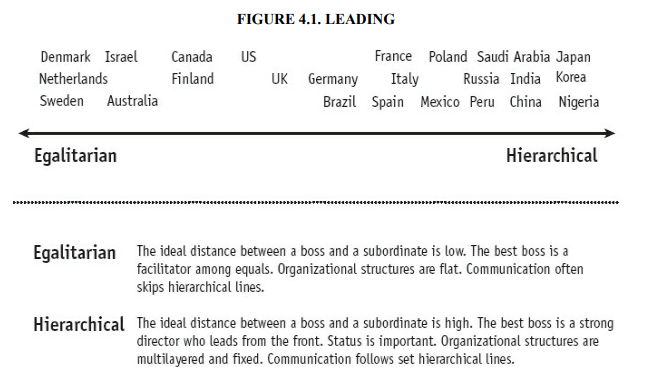
Some cultures, such as the Netherlands, tend to prefer egalitarian leadership, where the best bosses are “just one of the guys,” it’s OK to disagree with the boss, you can make decisions without getting the boss’s approval, and it’s normal to interact with people several levels above or below you. Other cultures, such as Japan, tend to prefer hierarchical leadership, where leaders have a special, separate status, it’s rare to disagree with the boss (especially in public), you typically seek the boss’s approval for decisions, and communication follows the hierarchical chain. If you try to be “one of the guys” in a hierarchical culture, you may be perceived as a weak leader, and you may embarrass your team; if you try to be a “head honcho” in an egalitarian culture, you may be perceived as an ineffective tyrant.
If you are working with people from a hierarchical society:
- Communicate with the person at your level. If you are the boss, go through the boss with equivalent status, or get explicit permission to hop from one level to another.
- If you do e-mail someone at a lower hierarchical level than your own, copy the boss.
- If you need to approach your boss’s boss or your subordinate’s subordinate, get permission from the person at the level in between first.
- When e-mailing, address the recipient by the last name unless they have indicated otherwise—for example, by signing their e-mail to you with their first name only.
If you are working with people from an egalitarian society:
- Go directly to the source. No need to bother the boss.
- Think twice before copying the boss. Doing so could suggest to the recipient that you don’t trust them or are trying to get them in trouble.
- Skipping hierarchical levels probably won’t be a problem.
- In Scandinavia, the Netherlands, and Australia, use first names when writing e-mails. This is also largely true for the United States and the United Kingdom, although regional and circumstantial differences may arise.
5. Deciding
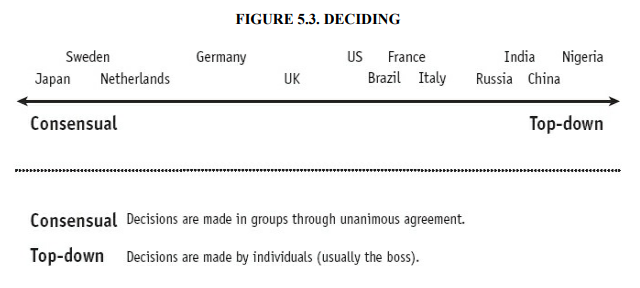
Some cultures, such as Japan, prefer to make decisions though consensus, where you get everyone’s input and buy-in before making a decision. Other cultures, such as Nigeria, prefer to make top-down decisions, where a single person (typically the boss) makes the call, and everyone else falls in line.
Note that the type of decision in consensual vs top-down cultures can be different:
In a consensual culture, the decision making may take quite a long time, since everyone is consulted. But once the decision has been made, the implementation is quite rapid, since everyone has completely bought in and the decision is fixed and inflexible—a decision with a capital D, we might say. Thus, the moment of making the decision is taken quite seriously as the pivotal point in the process.
By contrast, in a top-down culture, the decision-making responsibility is invested in an individual. In this kind of culture, decisions tend to be made quickly, early in the process, by one person (likely the boss). But each decision is also flexible—a decision with a lowercase d. As more discussions occur, new information arises, or differing opinions surface, decisions may be easily revisited or altered. So plans are subject to continual revision—which means that implementation can take quite a long time.
Most hierarchical cultures prefer top-down decision making, and most egalitarian cultures prefer consensual decision making, but there are exceptions: e.g., the US leans more towards egalitarian, but tends to use top-down decision making, while Germany leans towards hierarchical, but tends to use consensual decision making.
6. Trusting
There are two forms of trust: cognitive trust and affective trust:
Cognitive trust is based on the confidence you feel in another person’s accomplishments, skills, and reliability. This is trust that comes from the head. It is often built through business interactions: We work together, you do your work well, and you demonstrate through the work that you are reliable, pleasant, consistent, intelligent, and transparent. Result: I trust you.
Affective trust, on the other hand, arises from feelings of emotional closeness, empathy, or friendship. This type of trust comes from the heart. We laugh together, relax together, and see each other at a personal level, so that I feel affection or empathy for you and sense that you feel the same for me. Result: I trust you.
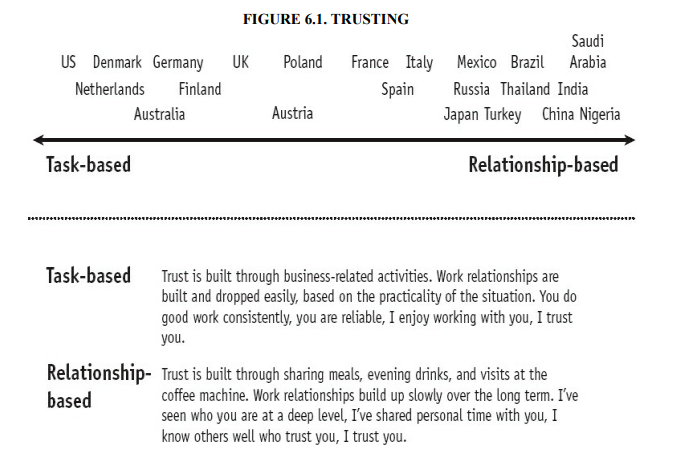
Although just about all personal relationships are based on affective trust, when it comes to business relationships, some cultures, such as as the US, are happy to do business solely based on cognitive trust (trust is task-based, and relationships can be built and dropped quickly), whereas other cultures, such as Saudia Arabia, will only do business if there is also affective trust (trust is relationship-based, and relationships are built over a long period of time).
Note that friendly is not the same friendship: that is, some cultures that are outwardly friendly are not necessarily relationship-based. There are two models of interaction: peach and coconut.
In peach cultures like the United States or Brazil, to name a couple, people tend to be friendly (“soft”) with others they have just met. They smile frequently at strangers, move quickly to first-name usage, share information about themselves, and ask personal questions of those they hardly know. But after a little friendly interaction with a peach person, you may suddenly get to the hard shell of the pit where the peach protects his real self. In these cultures, friendliness does not equal friendship.
[…]
In Minnesota, where I was raised, we learn at a very young age to smile generously at people we’ve just met. That’s one characteristic of a peach culture. A Frenchwoman who visited with my family was taken aback by Minnesota’s “peachiness.” “The waiters here are constantly smiling and asking me how my day is going! They don’t even know me. It makes me feel uncomfortable and suspicious. What do they want from me? I respond by holding tightly on to my purse.”
On the other hand, coming from a peach culture as I do, I was equally taken aback when I came to live in Europe. My friendly smiles and personal comments were greeted with such cold formality by the Polish, French, German, or Russian colleagues I was just beginning to know. I took their stony expressions as signs of arrogance, perhaps even hostility.
In coconut cultures such as these, people are more closed (like the tough shell of a coconut) with those they don’t have friendships with. They rarely smile at strangers, ask casual acquaintances personal questions, or offer personal information to those they don’t know intimately. It takes a while to get through the initial hard shell, but as you do, people will become gradually warmer and friendlier. While relationships are built up slowly, they tend to last longer.
[…]
If you are a peach person traveling in a coconut culture, be aware of the Russian saying “If we pass a stranger on the street who is smiling, we know with certainty that that person is crazy . . . or else American.” If you enter a room in Moscow (or Belgrade, Prague, or even Munich or Stockholm) and find a group of solemn-looking managers who make no effort to chat, do not take this as a sign that the culture does not value relationship building. On the contrary, it is through building a warm personal connection over time that your coconut-culture counterparts will become trusting, loyal partners.
If you’re going to work with a relationship-based culture, you’ll have to take the time to build a relationship (to build affective trust). You’ll need to have meals together, or go out for drinks, or do other explicitly non-work activities where you let your guard down, show your true self, and build a friendship. Only after you’ve done that will you be able to do business.
7. Disagreeing
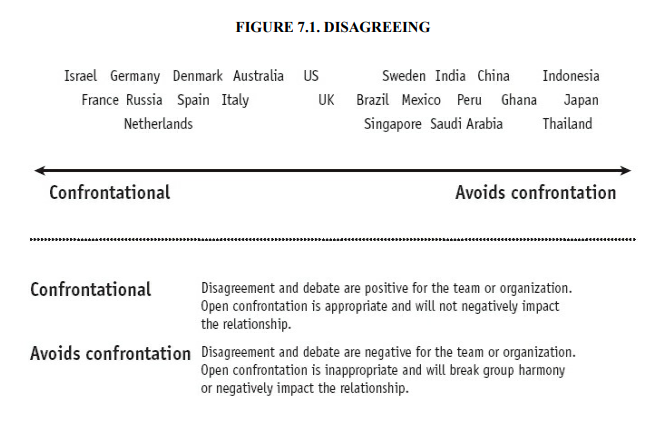
Some cultures, such as Israel, disagree in a confrontational manner, with public and vigorous debate seen as normal, and not something that negatively impacts the relationship. Other cultures, such as Japan, try to avoid confrontation, as public debate is seen as inappropriate, and something that is likely to hurt the relationship.
Cultures that are confrontational, such as Germany, see debate as a healthy way to understand and engage with an issue better, and they are able to separate the person from the opinion being debated:
We have this word in German, Sachlichkeit, which is most closely translated in English as “objectivity.” With Sachlichkeit, we can separate someone’s opinions or idea from the person expressing that idea. A German debate is a demonstration of Sachlichkeit. When I say “I totally disagree,” I am debating Erin’s position, not disapproving of her. Since we were children, we Germans have learned to exercise Sachlichkeit. We believe a good debate brings more ideas and information than we could ever discover without disagreement. For us, an excellent way to determine the robustness of a proposal is to challenge it.
[…]
If we are challenging you, it is because we are interested. You Americans take things so personally. If your German colleagues challenge a decision made by the leader of your country, a person you support and admire, there’s no need to get emotional or patriotic. Just calmly provide your perspective, in a rational manner, and you will likely find your workmate is simply interested.
Cultures that avoid confrontation, such as many Latin American and Middle Eastern cultures, may have people who speak with passion, but they can be sensitive and easily bruised, as they find it hard to separate the person from the opinion (if you’re attacking my opinion, you are attacking me). Therefore, to protect relationships, these cultures tend to avoid open debate.
Here’s a nice trick from the book on how to encourage some open debate, even amongst cultures that tend to avoid confrontation:
Before expressing disagreement, I now always explain, “Let me play devil’s advocate, so we can explore both sides.” Most groups seem happy to do this, as long as I am clear about what I am doing and why I am doing it.
8. Scheduling
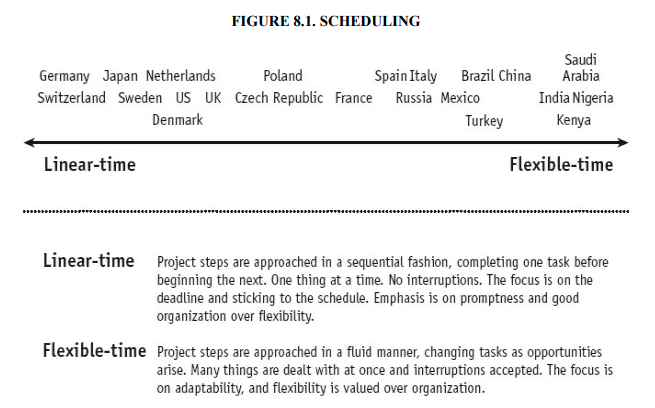
Some cultures, such as Germany, lean towards a linear-time mindset, where they value value promptness and organization. Some cultures, such as Nigeria, lean towards a flexible-time mindset, where they value flexibility and adaptability. And some cultures, such as France, fall somewhere in between. For example, if you schedule a meeting at 9:00am, a German will be there at 9:00am on the dot, a Frenchman might not get there until 9:07 or 9:10, and a Nigerian might be not be there until 9:30, 10:00, or later.
Part of this comes from how predictable and reliable things are in that culture:
What these Germans do not understand is that things are always changing in Nigeria. I can’t possibly schedule a meeting three months from today because it is impossible to know what will have changed. I am from the Muslim part of Nigeria, and where I live you don’t even know when the holiday is going to start until the Supreme Leader looks at the moon and says that the holiday starts now. If I don’t know which days will be a holiday, how can I possibly know at which moment two months and seven days from now I will be available to talk on the phone?
In cultures where things are more chaotic, instead of promptness, there is more value placed on being flexible enough to handle whatever life throws at you.
An example map
Here’s an example comparing Israel and Russia across the 8 dimensions:
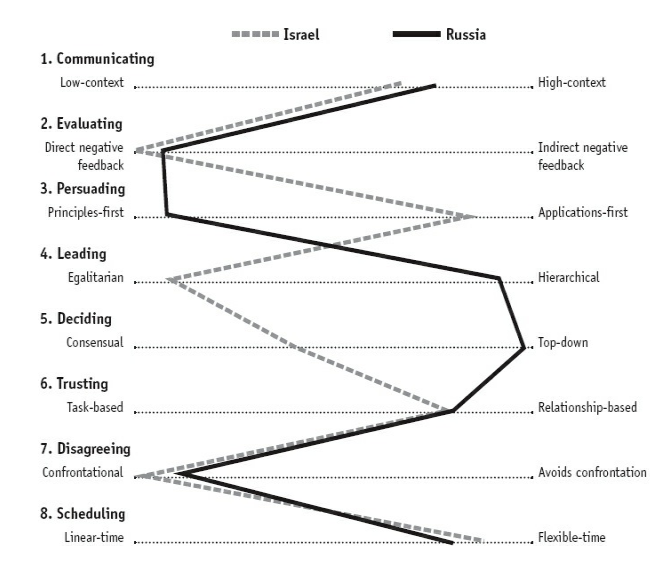
Note that, when interacting with another culture, what matters is not the absolute value of where they land on each dimension, but the relative value of how they compare to where you are on that same dimension. For example, Russia is on the far left of the disagreeing dimension, but since Israel is even further to the left relative to Russia, a Russian may find an Israeli to be even more confrontational than they are used to.