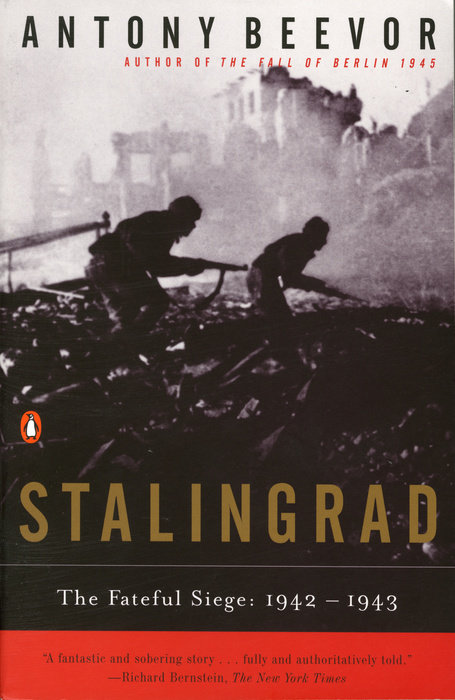
A detailed account of the Battle of Stalingrad, which was a key turning point in World War II, and perhaps a key turning point in all of modern history. The book is a detailed, thoroughly researched, and fascinating account of how Russia managed to not only hold Stalingrad, but to turn the tables, and encircle and defeat Germany’s massive Sixth Army.
I knew what happened in Stalingrad at a high level, but this book covers it at every level: the politics that led to it, the tactical battle plans, the supply chain issues, letters from individual soldiers, interviews with survivors, and much more. Here are just a handful of the interesting new things I learned from this book:
-
Stalin repeatedly ignored critical intelligence. Before Germany declared war on Russia (Operation Barbarossa in 1941), the German minister warned the Russians that an invasion was coming. Stalin thought it was misinformation. A year later, a German leader was shot down while flying over Russia, and the Russians were able to recover the full German battle plans from him. Stalin dismissed them out of hand as forgeries. Again and again, Stalin’s paranoia led him to ignore vital intelligence.
-
Stalin absolutely refused any sort of surrender. Order No. 227 became known as “Not One Step Backwards.” Anyone who abandoned their post or in any way talked of surrender was shot. When a line of Russian soldiers was sent to attack a position, there would be another line of NKVD soldiers pointing guns at their back, and if they faltered or tried to run, they would be shot. Any Russian prisoners of war who managed to escape German prisons returned to Russia, only to be immediately sent to the Gulag, and treated as traitors. One the one hand, the cruelty of this is unimaginable, and it actually led to many Russians joining the German army. On the other hand, who can say if this refusal to surrender is what ultimately allowed Russia to hold on to Stalingrad, and ultimately defeat the Germans?
Vasilevsky returned that evening with the draft of Order No. 227, more commonly known as ‘Not One Step Backwards’. Stalin made many changes, then signed it. The order was to be read to all troops in the Red Army. ‘Panic-mongers and cowards must be destroyed on the spot. The retreat mentality must be decisively eliminated. Army commanders who have allowed the voluntary abandonment of positions must be removed and sent for immediate trial by military tribunal.’ Anyone who surrendered was a traitor to the Motherland’. Each army had to organize ‘three to five well-armed detachments (up to 200 men each)’ to form a second line to shoot down any soldier who tried to run away. Zhukov implemented this order on the Western Front within ten days, using tanks manned by specially selected officers. They followed the first wave of an attack, ready ‘to combat cowardice’, by opening fire on any soldiers who wavered.
-
Hitler absolutely refused to back down. Early on, when it seemed inevitable that the Germans would take Stalingrad quickly, Hitler and his propaganda team publicly announced to Germany that victory was all but assured. He tied his ego to taking the city named after Stalin, so when things started to go south, Hitler absolutely refused to back down in any way. The Germany Sixth Army had multiple chances to escape, regroup, and either survive or try again, but Hitler wouldn’t hear of it, ultimately leading to their total defeat.
-
The Germans nullified their own blitzkrieg advantage. Stalingrad was reduced to rubble by German bombers, which made the city nearly impassible to motorized transport. As a result, instead of German armor giving them the advantage in a fast-moving blitzkrieg, they got tied down in street fighting, with small squads of men battling it out from building to building.
‘Factory walls, assembly lines, the whole superstructure collapses under the storm of bombs,’ wrote General Strecker to a friend, ‘but the enemy simply reappears and utilizes these newly created ruins to fortify his defensive positions.’
-
Russia managed to out-produce Germany. Russia, despite losing many industrial centers early in the war, mobilized enough to significantly out-produce Germany in tanks and munitions. One reason for this was that Russia encouraged women to participate in the work force, whereas Germany was more traditional, and mostly stuck with men. Another reason was that Russia was more willing to tolerate awful working conditions, trading human lives for additional productivity.
-
Operation Uranus. This was the big counter-attack that turned the tide. The first part of the operation was to pull the Germans deeper and deeper into Stalingrad, using the minimum number of men to not fully lose the city, but to give the Germans enough progress so that they would become overconfident. The second part of the operation was to encircle the German army with over a million Russian soldiers coming from many different fronts. To keep this hidden from the Germans, the Russians put in place a huge amount of misdirection and misinformation: e.g., they built up fake defenses and fake bridges in other places to make it seem like the focus was elsewhere.
-
The Germans made mistake after mistake. The Germans had multiple opportunities to break the encirclement, but they made numerous mistakes. Some of these mistakes were made by Hitler directly, who was micro-managing the army from afar. Some of the mistakes were made by his generals, in part because, with Hitler breathing down their neck, many of them became less proactive, and didn’t react in time to prevent encirclement. Even encircled, Hitler did not allow his army to surrender, so thousands died needlessly in extra battles, until they ultimately surrendered one unit at a time. Many Germans and Russians also died of cold, starvation, and disease. All told, Germany lost around half a million men in this battle (wounded, captured, killed).