Wow. This is Sci Fi at its best. It’s a bit hard to get into, as you’re thrown into the middle of a massive universe, full of unfamiliar characters, factions, religions, technologies, with no real introduction or explanation (the ultimate “in medias res”). But if you stick with it, you’re rewarded with ~7 incredible, interrelated tales (one from each major character), deeply imaginative world-building, exciting action scenes, wonderful mysteries, and lots of mind-bending ideas.
Some of my favorite concepts in this book:
(spoiler alert)
-
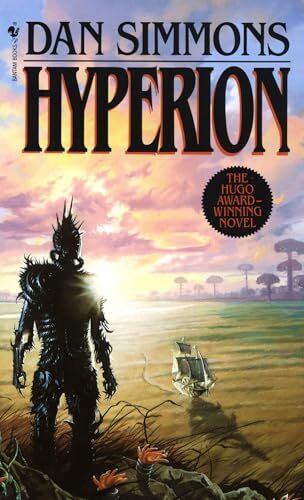
The shrike: three meters tall, roughly humanoid, black metallic skin, four arms, covered in blades and thorns, glowing red eyes, sharp metal teeth, ability to travel through time, deeply mysterious, with a nasty habit of impaling its victims on a metal tree of pain. That is quite the villain! Also, it turns out that it’s named after the shrike bird, which impales its own victims (insects and other small prey) onto thorns.
-
Farcasters: portals that allow instantaneous travel across vast distances. In the book, several hundred worlds are connected via a Farcaster network known as the WorldWeb. Each world has thousands of Farcaster portals and the books makes fantastic use of them. Brawne Lamia’s chase scene was amazing, with her running from Farcaster to Farcaster, jumping world to world, sprinting through a city at one moment, a dessert the following minute, an ice planet a minute later, and so on. I also loved the idea of rich people building houses where the doors are Farcasters, so each room is on a different planet: you can have a living room with views of the mountains on one planet, a bedroom with a skylight looking upon the stars from a different planet, and a bathroom on an idyllic beach on yet another planet.
-
The TechnoCore: a mysterious civilization of self-aware AIs. They develop advanced technologies (including the Farcasters) and even make use of “cybrids,” which are cloned humans controlled by the AI. It turns out the TechnoCore consists of multiple factions, some of which want to work with humans, while others want to destroy them. This must have inspired the Mass Effect series and its Geth collective.
-
The factions/civilizations: the Hegemony of Man is a collection of the several hundred planets on the WorldWeb; the Ousters are a group that abandoned the WorldWeb after the original earth was destroyed (via a black hole created in a scientific accident that later turns out to have been planned) and now live in space stations between the stars (and as a result, their minds and bodies have changed); and the Outback, which is all the colonized planets not connected to the WorldWeb (some by choice, though some are eventually forced to) that can only be reached at a cost, as even with faster-than-light travel, you lose years or even decades due to time dilation. I love the interplay amongst these groups. Also, this must have inspired The Expanse series, with its earthers, belters, and martians.
-
Time: the story prominently features the ability to manipulate time. The shrike can seem to pop in and out of time, pause it at will, and seems largely unstoppable as a result. The planet called Hyperion has “Time Tombs” on it that seem to be traveling backwards through time (what a weird concept!). And a character named Rachel, after visiting the Time Tombs, gets struck with an affliction where she begins to live her life backwards, each day getting younger and younger, and losing all memories of her “future.”
-
Christianity: the tale of Father Hoyt and Father Duré were especially memorable. Father Duré goes to live on another planet with a mysterious tribe of largely unintelligent people called the Bikura. There, he discovers the Bikura worship at an ancient church: one that seems to predate space travel and Christianity on earth! He then discovers the “cruciform,” a glowing creature shaped like a cross. Both events inspire his faith until he learns the horrible truth: the cruciform is a parasite. It embeds itself in the host’s chest, spreads its tendrils through the mind, and can control the host by causing pain (talk about a dark allegory for religion!). But it gets even crazier: if the host dies, the cruciform can rebuild the host’s body, and resurrect them, making the host immortal—at a cost. The cruciform rebuilds the host’s body the way it wants to, removing the host’s sexual organs and most of its intelligence. Father Duré tries to escape, but is unable to go more than a short distance before the cruciform causes him horrible pain, causing him to return. But he realizes the pain hurts the cruciform too. Not sure if I’ll ever forget the scene where Father Duré’s body is discovered, self-crucified upon “lightning rods” in the flame forest, having been electrocuted, burned, killed, and resurrected countless times over 7 years…
What a book. Can’t wait to read the next one.