How fast should you be able to run? How much should you be able to lift? How fit is fit enough?
A couple years ago, I was talking with my physical therapist1 about the health & fitness goals I had set for my myself, such as running a 5K in a certain time or deadlifting a certain weight, and he looked at me, and asked me two questions.
The first question was, why those specific numbers? It’s such a simple question, but I struggled to answer it because the truth was dumb and embarrassing. What was I supposed to say? Because I picked the numbers out of a hat? Because I saw some guy on Twitter with a blazing fast 5K time, and I was envious? Because if I could just deadlift that number, then everyone at the gym would drop what they were doing, and give me a standing ovation?
The second question was, what happens when you hit those numbers? This was even more embarrassing. I knew exactly what would happen if I hit my goals. Years ago, I hit a deadlift goal I had been chasing my whole life: 495 lbs.2 I didn’t get a standing ovation, but I got a “nice!” from my buddy, and we celebrated… For about 5 minutes. And then immediately I updated my goal to 585 lbs.
Since most of the training we’re exposed to comes from competitive sports, like powerlifting, running, Crossfit, and Hyrox, many of us default to setting arbitrary, ever-increasing goals. This makes sense for competitive athletes, where the answer to how fit you need to be is always, “more.” But if you’re not a competitive athlete, this approach to setting goals just leaves you perpetually unsatisfied, investing more and more time into exercise, and putting yourself at an ever higher risk of injury.
Like the vast majority of people who exercise, I’m not a competitive athlete, and I’m not trying to be one. I exercise so that I can be healthy, feel good, look good, and so I can be in good enough shape to do the things I enjoy in life for many more years. In this blog post, I’ll share the best approach I’ve found for setting health & fitness goals for people like me: percentiles.
Set goals using percentiles
Several years ago, I came across two studies3 that completely changed how I thought about health: these studies observed hundreds of thousands of people over decades, and they found that the best predictor of how long you’d live was not the usual suspects, such as coronary artery disease, diabetes, or smoking, but something else: your cardiovascular fitness, as determined by a standard treadmill test. And it wasn’t even close. Here’s how much each of these increased your relative risk of death from all causes:
| Health condition | Relative risk of death from all causes |
|---|---|
| Coronary artery disease | 1.29x |
| Diabetes | 1.40x |
| Smoking | 1.41x |
| Low cardiovascular fitness | 4-5x |
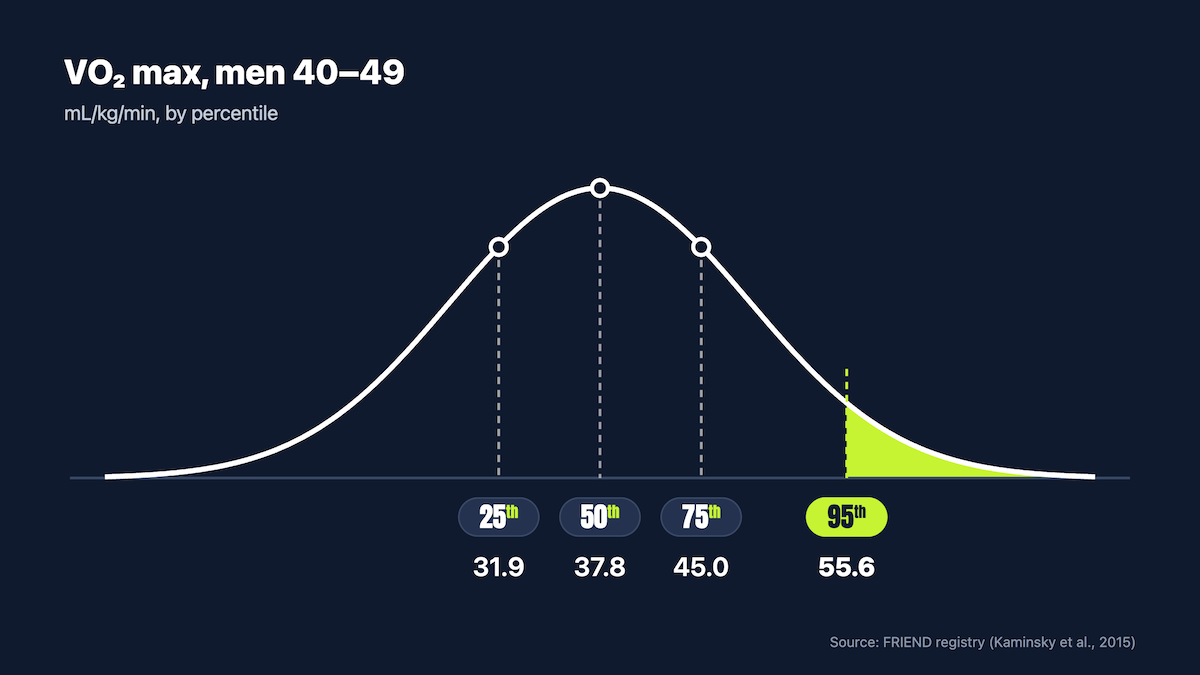
If you believe smoking is bad for your health, then you should be aware that being unfit is much, much worse. So, clearly, it’s important to achieve a high level of fitness. But what counts as a “low level” or “high level” of fitness? In these studies, these were defined using percentiles: low cardiovascular fitness was the bottom 20-25% of the population and high cardiovascular fitness was the top 2-5% of the population.
So that’s my recommendation: set goals using percentiles, ranked against people of the same age and sex in the general population. For example, aim to get your 5K time or deadlift into the 95th percentile, ranked against people of the same age and sex as you in the general population. If you do this, you get a number of benefits:
Goals that are achievable

With percentiles, you can pick a fairly ambitious target, such as the 95th percentile, but as its the 95th percentile relative to to the general population, rather than competitive athletes, it’s a goal that almost anyone can achieve. For example, here’s what the 95th percentile looks like for a handful of exercises for a man 40-49 years old:
- Run 5K: 21 min
- Bike 40K: 1h 27min
- Push-ups: 43
- Pull-ups: 12
These are not easy targets, but they are also nowhere near competitive numbers. With some work, almost anyone can get to this level, and if you do, the health benefits are massive, as per the next section.
Goals that maximize health benefits while minimizing costs
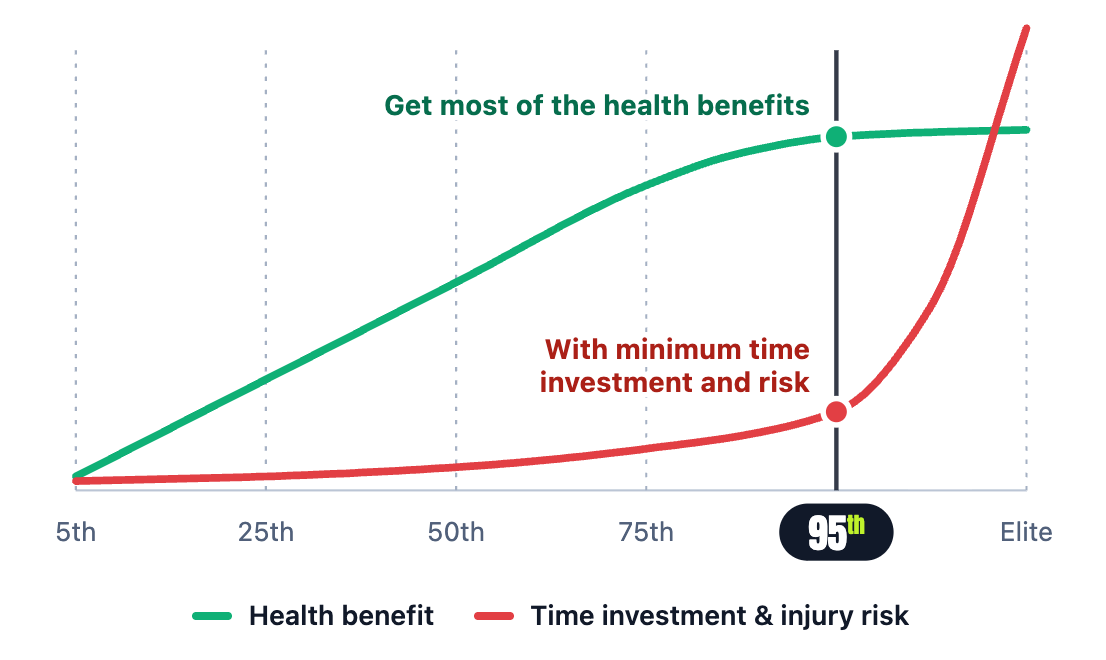
I find the 95th percentile is the sweet spot: it’s a high enough level of fitness to get you most of the health benefits, but not so high that it requires an unreasonable time investment or high risk of injury. For example, here’s my personal experience with increasing my deadlift:
| Deadlift strength | Health benefit | Time investment | Injury risk |
|---|---|---|---|
| 135 -> 225 lbs | High | Low | Low |
| 225 -> 315 lbs | Medium | Low | Low |
| 315 -> 405 lbs | Low | Medium | Medium |
| 405 and above | Negligible | High | High |
Going from 135 to 315 lbs gave me massive health benefits, making all sorts of every day lifting tasks (e.g., pick up a suit case, shovel wet snow, move a couch) much easier and safer, while keeping the time investment and injury risk low. Beyond that, I quickly saw diminishing returns. The 95th percentile for deadlift for me is around 335 lbs, which is right in that sweet spot where the health benefits start to flatten out, while the time investment and injury risk starts to climb rapidly.
Of course, everyone is a bit different, so the sweet spot for you might be the 85th percentile or the 98th percentile, but the point is that it’s a percentile target, with a clear definition of “enough.”
Goals for life
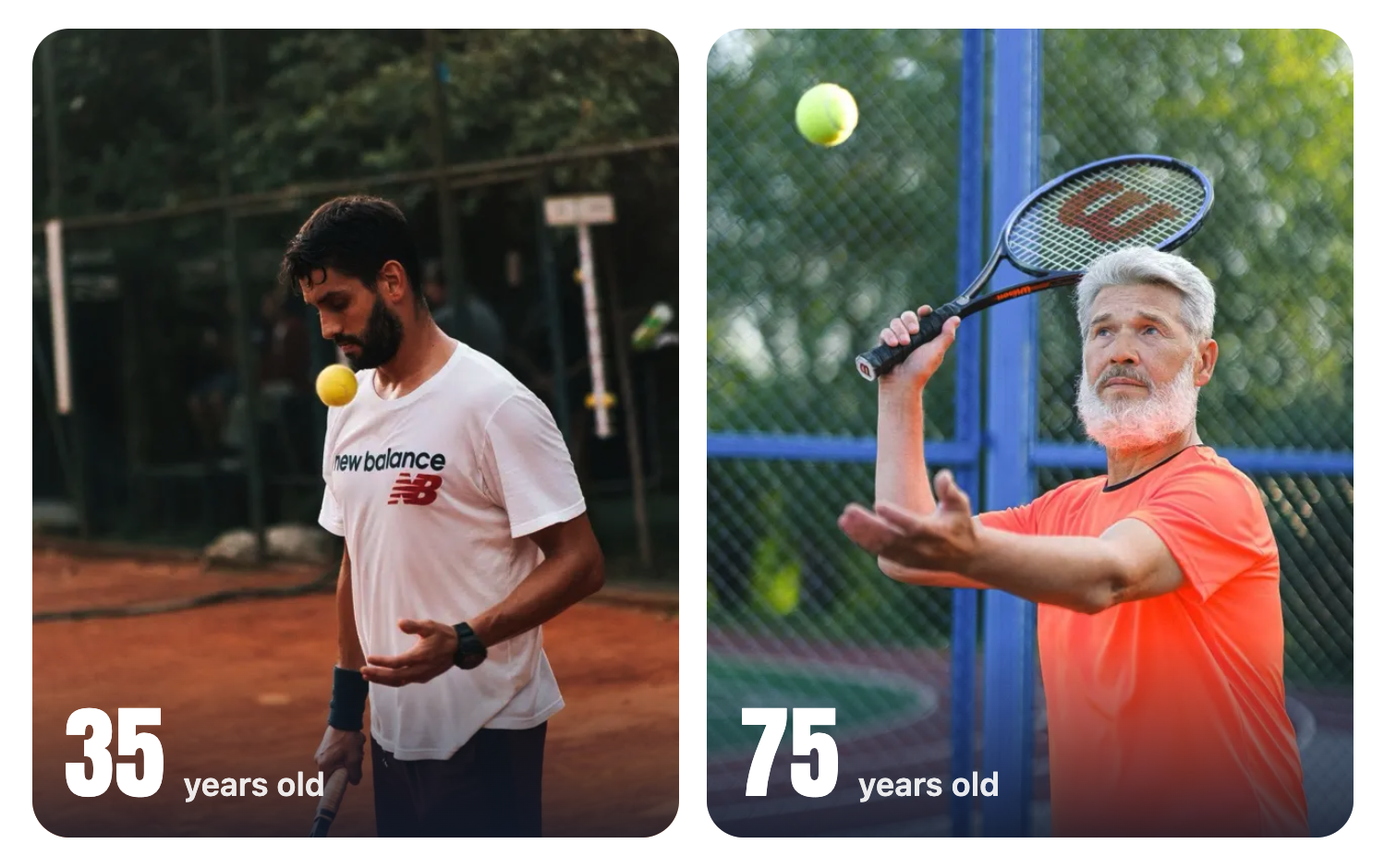
Percentiles are goals for life. I mean this in two ways.
First, as it’s far easier to maintain a level of fitness then to achieve that level of fitness in the first place, so once you achieve a percentile goal, you can actually reduce the time you spend on exercise, which gives you more time to spend on other things in your life. The point of percentile goals is make you healthy & fit enough to enjoy your life; not for exercise to replace your life.
Second, as percentiles are defined by age group, percentile goals update automatically as you get older. For example, whereas the 95th percentile for deadlift in my 40s is 335 lbs, in my 50s, it’ll be 292 lbs, and in my 60s, it’ll be 242 lbs. So the 95th percentile is the right target for elite health at any age.
Try it out in 95th
I built an app for iPhone and Apple Watch called 95th which lets you set goals based on percentiles:
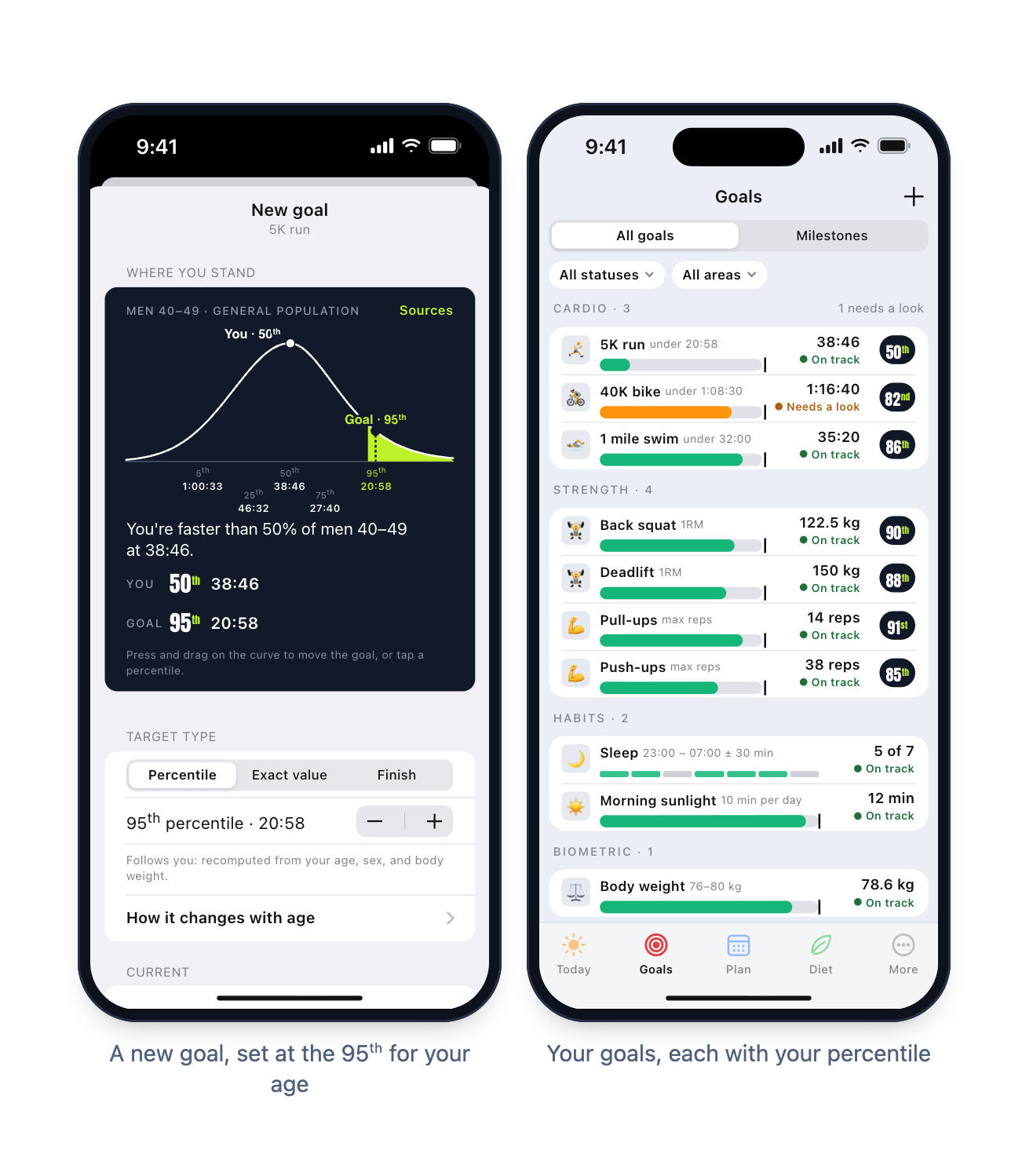
It has population data built-in for hundreds of different exercises, so you just pick the exercises you care about, the percentile you want to target, and the app does the rest. 95th can also create a plan to help you achieve those goals, help you track your diet, and much more. Check out the 95th website for all the details.
Footnotes
-
A big thank you to Shane at Dalkey Physical Therapy for his guidance over the years. ↩
-
Association of Cardiorespiratory Fitness With Long-term Mortality Among Adults Undergoing Exercise Treadmill Testing and Cardiorespiratory Fitness and Mortality Risk Across the Spectra of Age, Race, and Sex. ↩