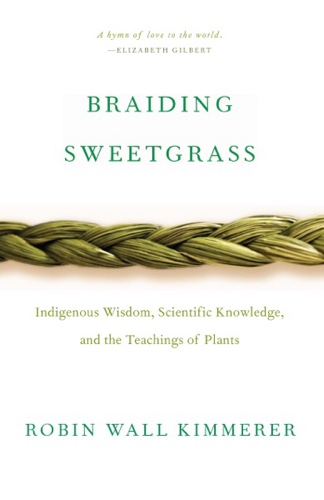
Robin Wall Kimmerer, a botanist and member of the Citizen Potawatomi Nation, weaves together scientific knowledge and indigenous teachings to explore our relationship with plants and the natural world. Through a series of essays drawing on her life as a scientist, a mother, and a Potawatomi woman, she argues that we should see the earth not as a collection of resources to exploit, but as a web of gifts that calls for gratitude and reciprocity. Although the writing can be beautiful, and the beginning of the book has a lot of moving and important ideas, the rest of the book seems to drift to random topics, repeat some of the same ideas, and ultimately, I found it a bit of a chore to come back to.
That said, those early parts of the book are full of insights, such as:
Gifts create relationships
Giving someone a gift creates a relationship between the giver and receiver. Buying something does not create a relationship between the vendor and consumer. The socks you got as a gift have a different meaning to you than the ones you bought at a store. The author grew up in a family without much money, and for them, gifts were always something you created for someone else; not something you bought. That strikes me as a lovely idea.
We’ve accepted banishment even from ourselves when we spend our beautiful, utterly singular lives on making more money, to buy more things that feed but never satisfy. It is the Windigo way that tricks us into believing that belongings will fill our hunger, when it is belonging that we crave.
Gifts come with responsibilities
When someone gets you a gift, you feel responsible for taking care of the item they give you, and you feel a responsibility to reciprocate. Again, this is different than the commercial world, where the items you buy come with rights, rather than responsibilities.
Gratitude and moral responsibility
Every life must take other lives in order to live. What is unique about humans is that we can show gratitude. We can be aware of what we are taking, so it is our moral responsibility to honor the lives we’ve taken, and to avoid wasteful consumption.
Market vs gift economy
One of the key ideas in this book is that we should try to move to more of a gift economy rather than a market economy; to move from private goods to gifts. For example, we should see our relationship with nature as a gift economy. When you grow food yourself, and you pick some fruit of a tree, you see that as a sort of gift. When you kill an animal with your own hands, you see that as a gift. In both cases, we have a responsibility to take care of that gift, and to be grateful to the giver. We lose that relationship when we buy food in a supermarket. And when we lose that relationship, the practices we adopt are much less healthy for ourselves and the world.
In some Native languages the term for plants translates to “those who take care of us.”
Each person, human or no, is bound to every other in a reciprocal relationship. Just as all beings have a duty to me, I have a duty to them. If an animal gives its life to feed me, I am in turn bound to support its life. If I receive a stream’s gift of pure water, then I am responsible for returning a gift in kind. An integral part of a human’s education is to know those duties and how to perform them.
Something is broken when the food comes on a Styrofoam tray wrapped in slippery plastic, a carcass of a being whose only chance at life was a cramped cage. That is not a gift of life; it is a theft.
If all the world is a commodity, how poor we grow. When all the world is a gift in motion, how wealthy become.
The interdependency of man and nature
Human interaction with nature doesn’t have to be negative. For example, unharvested plots of sweetgrass can become choked with dead stems, limiting their growth. if you harvest roughly half of the sweet grass, then it’ll grow back stronger, and you’ll end up with more sweetgrass than you started with. So as long as you don’t take too little or too much (see honorable harvest, above), our interaction can be a net positive for nature. We see this all over nature. For example, when buffaloes eat grass, their saliva and manure actually helps the grass grow. They also typically only eat about half the grass and don’t come back to the same spot for a long time, so the grass has a chance to grow back stronger.
The honorable harvest
The book talks about an indigenous practice known as “the honorable harvest,” which guides how you should exchange of life for life. It is a set of principles that has deep applicability in all areas of life:
- Know the ways of the ones who take care of you, so that you may take care of them.
- Introduce yourself. Be accountable as the one who comes asking for life.
- Ask permission before taking. Abide by the answer.
- Never take the first. Never take the last.
- Take only what you need.
- Take only that which is given.
- Never take more than half. Leave some for others.
- Harvest in a way that minimizes harm.
- Use it respectfully. Never waste what you have taken. Share.
- Give thanks for what you have been given.
- Give a gift, in reciprocity for what you have taken.
- Sustain the ones who sustain you and the earth will last forever.