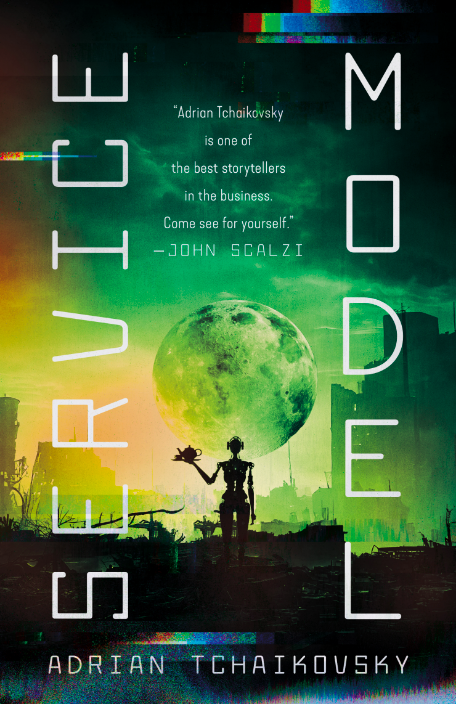
The story of Uncharles, a robot valet who has left the rich household he serves, and discovers that he lives in a futuristic world where human civilization has collapsed. Along the way, he runs into The Wonk, a robot who is on a quest to try to understand what caused the collapse. It’s a lovely story that explores what may happen to humanity if we give more and more responsibility to robots and automation.
The book is full of dry humor, much of it focused on the absurd situations robots can get into by rigidly following instructions, a bit like a comedic version of Asimov’s Robot Series. I found myself snickering often, and a few of the scenes are especially memorable:
(Spoiler Alert!)
- The robotic detective investigating the murder. A wonderful parody of detective stories (especially Poirot).
- The diagnostic center. The whole thing feels like a great take on the DMV, but blocked permanently due to lack of approvals from a human of level 7 or above.
- The library. Everything about the librarians is hilarious (the Lorem Ipsum robes, the burning of books), but the best is the realization of how they organize all the (binary) data by sorting all the 1s and 0s, and the logical paradox this leads to (if the archive contains “all possible knowledge,” then it must contain multiple, conflicting versions of itself).
- The automated door that waited all its life to be opened, and was deeply pleased when Uncharles finally asked it to open. This felt like a terrific homage to the happily-sighing doors from The Hitchhiker’s Guide to the Galaxy Series.
-
The titles for each part of the book. It took me ages to get it, but I finally understood that these are references to other authors who influenced that part of the book:
- KR15-T: Christie (Agatha).
- K4FK-R: Kafka (Franz).
- 4W-L: Orwell (George).
- 80RH-5: Borges (Jorge Luis).
- D4NT-A: Dante (Alighieri).
The book also contains plenty of (somewhat more serious) social commentary, including what happens to humanity if we rely too much on robots and automation, how hard (and perhaps absurd) it is to try to create AI “alignment,” the impact of economic and social inequality, and the absurdity of bureaucracy. The ending of the book is also a social commentary (I’ll avoid spoilers of that here), which is interesting, but felt a bit weaker than the rest of the book.
Overall, it’s an unusual, funny, and intriguing read.