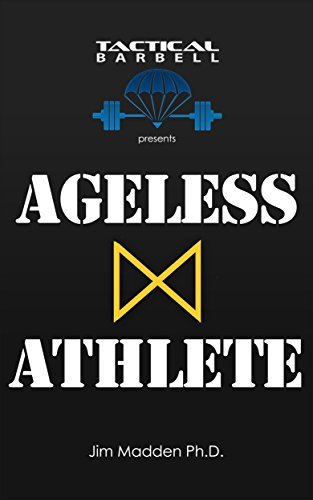
The fourth book in the Tactical Barbell Series takes the Tactical Barbell formula and adapts it for athletes over the age of 40. Whereas the first three books in the series are largely targeted at younger athletes in the military and military-adjacent fields, this book is more focused on older athletes who are not in the military (including the author, who is a Professor of Philosophy).
Given that I’m an older athlete who is not in the military, I thought this book would be perfect for me. I did get some insights here, but not nearly as many as the previous three books. An awful lot of this fourth book boils down to “do what the previous books say, but be a little more careful.” And while I agree with that advice, I probably didn’t need an entire book to learn that.
Still, there are a few good ideas in here, mostly about how to tweak the Tactical Barbell formula:
Prioritize recovery
For the most part, this book does not tell you to do less just because you’re older. You can do largely the same workouts, and still achieve a high level of performance (at least in your 40s and 50s). The big difference is in recovery. This is what gets noticeably worse as you get older.
For example, you can still squat heavy, perhaps even heavier than you did in your 20s, but whereas in your 20s, your legs would be feeling great 1-2 days later, in your 40s, your legs might need 2-3 days to recover after a heavy session.
So the major changes as you get older are not about doing less in your workouts, but about giving your body more time to recover:
- Take 1 day off completely per week. This is non-negotiable.
- Take 1 floating day off per week use as necessary. E.g., If you’re feeling particularly tired or stressed, it’s OK to skip one day’s workout.
- Take 1 week as a recovery week every 4-6 weeks. Don’t do any maximal strength or HIC work that week. Light endurance work is OK.
Minimize injuries
As you get older, the risk of injuries gets higher. Combined with the slower recovery mentioned in the previous section, injuries can be one of the biggest barriers to progress for older athletes. The book recommends the following:
- Pick high-yield, low-risk exercises. As you train, you’ll find that your body responds better to some exercises than others. For example, you might respond very well to squats: the more they do them, the stronger they get at all lower body movements. On the other hand, you might respond poorly to deadlifts: if you do them too often, you get fatigued and/or injured. Some people are the opposite. The idea is to figure out what works well for your body, and to pick the exercises that give you the highest yields (the best results in terms of performance) with the lowest risk of injury. There are no magic exercises that everyone must do, and what works best is going to be different for every person.
- Don’t do 1RMs too often. Testing your 1RM can be fun, but it has a heavy recovery cost, and a high injury risk, especially as you get older. Avoid doing it just for fun, or for ego boosting. If you need a 1RM to figure out the weights to use during strength training, in most cases, it suffices to do a 5RM, and use an online calculator to estimate your 1RM.
Focus on what you want to achieve, not what you want to avoid
If you say to yourself, “don’t think of a red elephant,” it’s very hard to prevent the image of a red elephant from entering your mind. A better way to accomplish the same thing is to think to yourself, “think of a blue elephant.”
More generally, instead of focusing on what you want to avoid, focus on what you want to achieve. For example, when doing a deadlift, instead of thinking “don’t lean too far forward” (focusing on what to avoid), it’s more effective to think, “keep the shoulders behind the bar.”
Consistency is king
A great quote from the book:
The same thing goes for your training. You don’t have to like it initially. You don’t have to act like you have a habit you don’t have yet. You just need to show up. That’s all you have to do on any given day. Just show up in the gym, at the track, in the pool, etc. Commit to doing only the least necessary to start. That’s all you need to do. Discipline is an acquired taste. If you really aren’t feeling up to it, commit to doing just half of your scheduled workout. Just show up-without any promises to yourself that your workout is going to be awesome. Your workout doesn’t have to be awesome to be effective. Your workout only needs to happen to be effective.
Protocol recommendations
For the most part, the book says to follow the protocols in the first two Tactical Barbell books. The two key differences I noticed:
- Use operator I/A. This is the protocol the book says will be the best fit for most older athletes. This lets you focus on a smaller set of exercises and gives you more flexibility with reps, rest, etc.
- Modified base building. This book includes a modified base-building protocol which includes an extra day of recovery each week, limits LSS work to just 30 minutes, and limits the strength-endurance work to a specific “Tango Circuit.”
Set training goals
Instead of working on all aspects of fitness equally, this book recommends setting specific training goals, and optimizing your training to focus on those goals while putting other aspects of fitness into “maintenance mode.” On a regular basis, assess your strengths and weaknesses, and sk yourself a question such as:
Will adding a few more pounds to my squat make more of an impact on my overall fitness than dropping my 5K time by a few minutes?
For example, if you currently have a 500 lb squat and a 25 minute 5K, dropping your 5K time to, say, 20 minutes will probably have a bigger impact on your overall fitness than increasing your squat to 520 lbs. In this case, you’re better off spending more time on endurance and HIC work, while reducing the time you spend squatting to just enough to not lose much progress. On the other hand, if you currently have a 100 lb squat and a 16 minute 5K, getting your squat to 200 lbs will probably have a bigger impact on your overall fitness than dropping your 5K time to 15:50, so you’ll want to spend more time on maximal strength and less on endurance and HIC.
Given limited time to train, and slower recovery, focusing on specific goals will typically produce better results than trying to work on everything all at once.
Weaknesses of the book
-
Fitness with no endpoint. While this book does recommend setting specific training goals, it doesn’t recommend setting reasonable end goals for each aspect of fitness. Just as I wrote in my review of the first Tactical Barbell book, it’s not necessary, nor practical, to forever be trying to increase all aspects of fitness. At some point, you are fit enough, and pushing beyond that point has a significant cost in terms of time, recovery, and injury risk. This is all the more important for older athletes, so I’m surprised this book didn’t address it.
-
Not enough on recovery. The book does a nice job discussing how you need to accommodate slower recovery as you get older, but there’s not enough material on how to do that. A few extra days of rest here and there is not sufficient. I expected to see more on common injuries as you get older (e.g., especially tendon and joint issues), injury recovery (e.g., physical therapy), injury prevention (e.g., tendon training, mobility work), useful recovery tools (of course sleep, rest, and nutrition are king, but what else helps?), and so on.
-
Not enough on routine tweaks. This book does talk about picking high-yield, low-risk exercises, but there aren’t enough real-world stories of what these are. I understand every person is different, but there are undoubtedly some trends we can spot. For example, for how many 70-year-olds is running still a reasonable exercise choice? What about deadlifts? Squats? If certain exercises tend to be impractical as you get older, what are the better alternatives?
-
Not enough on decline with age. The book tries to be uplifting for older athletes, talking about how you can still accomplish tremendous feats of fitness, even at an older age. I appreciate that. And to an extent, it’s true. But it also feels incomplete to not acknowledge that we do lose fitness every decade over age 40. You can slow that decline with exercise, and even reverse it, but not indefinitely. Eventually, you will be able to do less. I wish the book didn’t ignore that topic, but addressed it head on (even though it’s an unpleasant topic). What changes at age 50? 60? 70? What do you need to change in your training to accommodate it? The answer is not “just leave more time for recovery!”
-
Self-published? Just like the previous books, this one seems to be self-published, so the editing, typography, and cover design are all subpar.
Overall
This book is a decent entry in the Tactical Barbell Series, and arguably the one that should’ve been the most applicable to my own situation, but unfortunately, it’s the entry that adds the fewest new insights. It’s still worth reading if you’re in your 40s or older, but you’ll have to go to other sources to fill in some gaps.