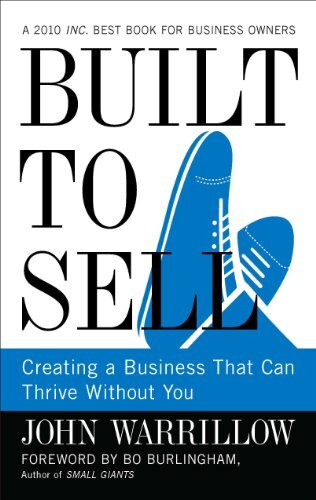
Must-read for most entrepreneurs and founders. The key takeaway is that you should build your business as if you’re going to sell it, even if you have no intention to actually sell it. That’s because a business that is sellable is usually a stronger and more enjoyable business in general.
Instead of a list of advice to follow, this book is written in the form of a story, where you follow around a fictional entrepreneur who is trying to transform his business into something that can be sold. Like most business books that try their hand at storytelling, the story leaves much to be desired: the plot isn’t exciting, the characters are flat stereotypes, the dialogue sounds like an infomercial, and the writing is a bit awkward and mechanical. But despite all that, it ends up being an effective way to deliver the key insights in this book.
Here are some of those insights:
Specialize
Don’t try to build a company that does a bit of everything. Instead, find a niche where you stand out, and dominate that one space. Aim to build a product company, where you become world-class at repeatedly delivering a single product, rather than an agency, where you customize your product for every customer.
Agencies have to do a bit of everything, which means they aren’t particularly good at any one thing, and are often trying to do things they aren’t qualified to do at all. By specializing, you are able to focus, and become the absolute best at one thing.
Don’t be afraid to say no
Customers will always ask you to do things outside your specialty and to customize your product for them. You must be brave enough to say no, even if that means turning business away. Remember that every time you say “no” to something custom and out of your wheelhouse, you will be able to say “yes” to something you’re good at.
Moreover, customers tend to have less respect for agencies and consultants—treating them like expendable labor, bullying them, blaming them for anything that goes wrong—whereas they may give you more respect if you say no and show them you’re a focused product company.
Build a business that can run without you
Focus on building a machine that anyone who is reasonably qualified/trained can execute, rather than a company that relies on heroics that only you can deliver. A business that can’t succeed without the owner is unsellable.
Build a predictable sales engine
You don’t want every sale to be unique; you shouldn’t be customizing the product for each customer; and you shouldn’t rely on “hero selling” (e.g., only the founder or a very charismatic sales person can make sales). Instead, the goal is to create a repeatable sales engine.
The first step is to create a repeatable sales process that is written down and can be trained to others. This will allow you to hire and train a sales team, rather than the founder doing all the sales.
Once you have a sales team, you should hone the process until it’s predictable: that is, you know that if you do X sales call per month, you’ll get, on average, Y sales per month. If you can do that, you can then predictably scale the sales team and the entire company.
Tips for the acquisition process
The book has a number of detailed tips on not only building a sellable company, but also the acquisition process itself:
-
If you’re interested in being acquired, consider getting a firm that specializes in acquisitions to represent you. These firms can actively go out to find you buyers, present your company to them, and help you in negotiations. The firm should be small enough that your deal size is meaningful to them (e.g., if the firm makes billions per year and your company is worth only a few million, they probably won’t spend much effort on you).
-
There are different types of acquirers. For example, strategic buyers want to buy your company as part of a larger business initiative (e.g., your company may become a marketing channel that will boost the acquirer’s core business); on the other hand, financial buyers want to buy your company to make money from it directly (e.g., by taking your profits). Strategic buyers are often willing to pay more, and are less concerned with profits, as they are really investing in what your company could help them accomplish in the future (so make sure to show them a vision of what they will be able to accomplish if they put their money into your business!), whereas financial buyers are just looking at what profit they can make right now (so make sure your financials are solid!). You can also break down buyers by those who are operators (they want to run and optimize the business) versus investment funds (who are willing to put in money, but otherwise are hands-off).
-
Avoid earn-outs. That is, avoid an acquisition where a large portion of the payout for the owner must be earned by achieving certain metrics. This gives all the up-side to the acquiring company and all the risk to the owner. In most cases, these earn-outs fail, and the owner walks away with no company, and little money earned.
-
Be wary of exclusivity clauses. Acquirers often put in non-binding offers, pending a due-diligence check. During this check, they also often ask for exclusivity. Due diligence can take a long time, be very invasive, and at the end, the acquirer may lower their offer or withdraw it entirely. Don’t go into this process lightly!
-
Recurring revenue typically leads to higher valuations. In order of increasing valuation: consumables (e.g., toothpaste); sunk-money consumables (e.g., razor blades for a specific handle or ink cartridges for a specific printer); subscriptions (e.g., magazines); sunk-money subscriptions (e.g., Bloomberg subscription for a Bloomberg terminal); auto renewal subscriptions (i.e., renews without customer having to explicitly do anything); contracts (e.g., phone contract).
-
Offering employees stock can make the acquisition process more complicated. Instead of offering employees equity, the author recommends cash reward payouts (e.g., essentially bonuses, but with a vesting schedule) and stay bonuses (i.e., another bonus that vests if you stay some period of time after an acquisition). I’m not sure if I agree with this advice, but the idea of cash bonuses with some sort of vesting was a new idea to me that’s definitely worth considering!