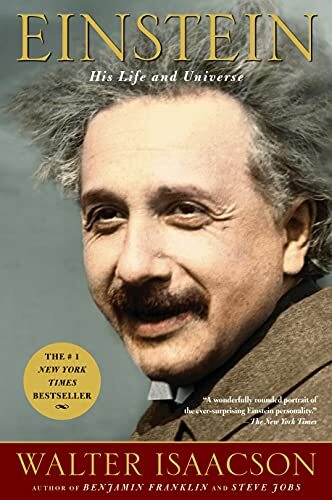
A delightful biography of a fascinating man. The book is well written and succeeds both at showing you what Einstein was like as a person and offering a down-to-earth explanation of some of his most important theories.
Some of my favorite learnings from this book:
-
Even Einstein couldn’t get a full professorship. Not even after he had published some of his most important papers (on the photoelectric effect, Brownian motion, special relativity, and the equivalence of mass and energy). So if you’re an academic struggling to get a job, just remember that even Einstein struggled with this :)
-
The book has a great description of the relativity of time. That is, the idea that there is no “fixed” time when an event happens. Time is only relative to the observer. For example, imagine you’re standing in the middle of a very long, straight railroad track. At the “exact same time”, a lightning bolt one mile to your left and another one mile to your right hit the tracks. How do you know it happened simultaneously? Because the light particles from those two bolts traveled one mile and reached your eyes simultaneously. Now imagine you were traveling in a train on those tracks, heading to your right. The information from the bolt on the right would reach your eyes before the one on the left, so to you, the bolt on the right hit first. Neither interpretation is wrong! There are no privileged reference frames. It’s fun to realize that information itself must travel and can’t go faster than the speed of light, so anything we know of the universe is always relative to an observer.
-
The book also has a wonderful description of Einstein’s theories about the size of the universe. He believed it was finite in size, but has no boundary. To understand this, imagine you live in a 2d plane (e.g. a sheet of paper). If your 2d universe was a piece of paper, then it would have a boundary. But if the piece of paper curved in on itself to form a 3d sphere, then there is no boundary: you could just go around and around forever. If that paper was sufficiently large compared to you, the observer, then you wouldn’t be able to see the curvature of the paper, just as a human cannot see the curvature of the earth. So you would think you’re going straight, forever and ever, but eventually, you’d end up right where you started, just like a video game. It’s also a great theory in that it implies the universe can expand, inflating our sphere a bit like a balloon. Of course, our universe is 3d (or 4d if you include time), so spacetime curves back on itself in some sort of 5d equivalent of a sphere. We can’t imagine it, just as a being living in 2d couldn’t imagine 3d (see: Flatland).
-
There is a great debate revealed in the book over what physics really is. Einstein believed that there is some truth out there that exists independent of us, and physics is the attempt to discover that truth. Niels Bohr believed that physics isn’t a study of what the universe is, but merely what we can observe of it. That is, there is no reality independent of us. A lot of quantum mechanics seems to indicate Bohr was right, which is a mind-bending idea. Especially fun were the arguments between Einstein and Bohr.
Einstein: God does not play dice.
Bohr: Einstein, don’t tell god what to do.