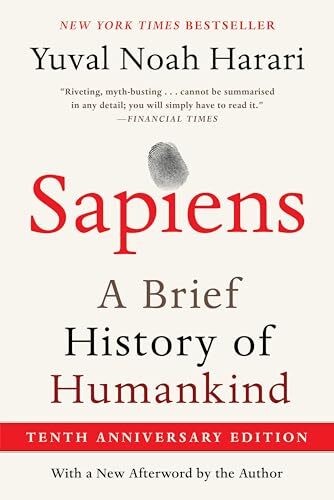
This book is nothing if not ambitious. It tries to tell the entire history of humankind and answer some of the most complex questions known to man, including what is happiness and what is the meaning of life, all in under 500 pages. I may not agree with some of the answers, but I thoroughly enjoyed hearing Harari’s perspective, as he did a brilliant job of getting you to see new perspectives and think through issues in new ways. Here are some of the most interesting discussions from the book:
There were six different species of humans
At one time, six different species of humans roamed the earth.
- We all hear about neanderthals and other types of hominids, but it’s always depicted as a linear progression from the “primitive” ones to the modern Homo sapiens.
- In reality, many types of hominids existed at the same time, and some of them were in more “evolved” than us (e.g. neanderthals were stronger and had larger brains).
- I used to laugh at Star Trek, where all the alien species were just humans with weird ridges on their heads, but at some point in history, earth probably looked just like that.
- And yet now, only Homo sapiens remains.
Homo sapiens biggest advantage was believing in myths
What separated Homo sapiens from other animals, including our closest relatives such as the Neanderthals, may be our ability to believe in fictions and myths, such as:
- Religion
- Law
- Money
- Human rights
All of these are just figments of our imagination, but the fact that we all collectively believe them gives us incredible power to organize.
- Whereas most animals cannot function in groups larger than a few dozen, humans can create orderly societies of millions.
- All of that order is only possible because we believe in common fictions, such as the right of someone to rule, or that a green piece of paper is worth something.
- Of course, to make such a system work, we must never admit that these are just “beliefs.”
- We must adamantly claim that these are “natural truths.”
We’ve never lived in harmony with nature
- Don’t believe the tree huggers when they tell you that, in the past, humans “lived in harmony with nature.”
- The reality is that through almost all of human history, from our earliest days, we have been destroying ecological systems and making countless animals go extinct.
- It is only in modern times that we are finally aware of that and could, if we wanted to, finally put a stop to that.
Plants and animals domesticated us
Here’s a fun thought: plants and animals domesticated human beings. Not the other way around.
- We used to be wandering nomads.
- It was the wheat plant and the cow that forced us to change our entire lifestyle to settle down as farmers.
Farming initially reduced the quality of life
Although most of humankind replaced a hunting & gather lifestyle with farming, the reality is that the life of the typical farmer was actually worse than that of a typical hunter & gatherer.
- Farmers, on average, spend more time working, eat a more restricted diet, and are less healthy than hunters & gatherers.
- It is only in very recent times that our “settled down” lifestyle has led to a more relaxing life than hunters & gatherers.
- However, for the vast majority of the last ~10,000 years of agriculture, it was worse.
Farming may have been a luxury trap
So why, then, did we move to farming? One answer could be the luxury trap:
- Growing wheat lets you feed more people than hunting & gathering.
- However, this food surplus doesn’t let you relax and live the easy life, as it usually leads to a higher birth rate, and therefore, more mouths to feed.
- As a result, even though you have better technology that should enable a better lifestyle, your consumption levels rise and your life is no better, and sometimes even worse, than before.
You see the same pattern other places too:
- Email lets you send and receive messages faster than ever before, but instead of spending less time on messages, we’ve vastly increased the number of messages we send, and therefore, end up spending more time on them.
- The reason it’s a “trap” is that once you’ve adopted the new “luxury”, you can never go back, even if that luxury makes your life measurably worse.
- You can never switch back to snail mail once you’ve adopted email, as you won’t be able to keep up with the volume of messages you need to send, and you can never go back to hunting & gathering once you’ve adopted farming, as you’ll never be able to feed all the mouths you have now.
The modern world is possible due to credit
Much of modern economic growth is only possible because of credit: that is, people being willing to loan other people money.
- The only rational reason to loan someone money is if you believe the future will have more wealth than the present.
- For most of human history, this was not true.
- Everyone believed the world would stay the same, or possibly get worse.
- In recent times, thanks to technology, each new generation had more wealth than the last, which makes the idea of loaning money a better proposition, which allows more business and technology to be created, which creates more wealth, which makes the idea of loaning money seem even better, and so on.
Modern nation states can’t go to war
- Modern nation states can’t declare war on each other because they aren’t independent.
- International trade and globalization has made us all interdependent, like one big state.
Happiness is relative
Happiness is often correlated with the difference between subjective expectations and objective reality.
- If you expected a bike and got a Toyota Corolla, you’d be thrilled.
- If you expected a Ferrari and got a Corolla, you’d be pissed.
Perhaps the modern world, by constantly exposing us to insane expectations (through TV, Internet, magazines, etc.) is making us less happy, as those expectations can never be met.
- If a young man who lived a few hundred years ago in a remote village of 50 people, it’s likely that he would feel attractive and confident simply because, statistically, there are going to be very few other men in that village who are likely to be more attractive than him.
- However, in the modern world, where you are constantly bombarded with images of the most attractive celebrities and athletes from a population of billions, that same young man has no chance of being the most attractive, and is much more likely to feel ugly and inferior.
Overall
In case it’s not obvious, I took lots of notes while reading this book, and it made quite an impression on me.
The only real downside is that, at times, the book is a bit too cynical. For example, one of the chapters makes the argument that that liberalism, communism, and capitalism are effectively religions and can only be justified through monotheistic beliefs. This, much like the argument that morals can only come from God, is easy to disprove. For example, the idea of human rights can arise purely from self-interest, without the need to rely on a monotheistic God as justification. That is, I want every person to have rights and protections because I too am a person and may need to avail of those rights some day. More generally, you can explain many modern day ideologies by asking “what if everyone acted that way?” and following the logical chain to see if you’d want to live in a world like that. Example: what if everyone was allowed to commit murder? Clearly, from a purely selfish perspective, that would not lead to a good world for me. Therefore, I believe murder is “wrong”, and I don’t need any religious belief in “souls” or “sins” to reach that conclusion.
In other words, although I buy Harari’s argument that belief is a huge part of what makes sapiens special, I don’t think you can claim that all beliefs are created equal. The practical utility of a belief is something that can be measured objectively. Does it lead to a better society? Does it make more likely that I’ll live a happy and pleasant life? If so, such a belief can be justified on purely selfish and logical grounds, and is not in the same category as purely religious beliefs, which are based in pure fantasy.
All that said, it’s a great read.
Quotes
Finally, some of my favorite quotes from the book:
The romantic contrast between modern industry that “destroys nature” and our ancestors who “lived in harmony with nature” is groundless. Long before the Industrial Revolution, Homo sapiens held the record among all organisms for driving the most plant and animal species to their extinctions. We have the dubious distinction of being the deadliest species in the annals of life.
Money is the most universal and most efficient system of mutual trust ever devised.
Each year the US population spends more money on diets than the amount needed to feed all the hungry people in the rest of the world.
So, monotheism explains order, but is mystified by evil. Dualism explains evil, but is puzzled by order. There is one logical way of solving the riddle: to argue that there is a single omnipotent God who created the entire universe – and He’s evil. But nobody in history has had the stomach for such a belief.
The Scientific Revolution has not been a revolution of knowledge. It has been above all a revolution of ignorance. The great discovery that launched the Scientific Revolution was the discovery that humans do not know the answers to their most important questions.
Everyone always wants money because everyone else also always wants money
Just 6 million years ago, a single female ape had two daughters. One became the ancestor of all chimpanzees, the other is our own grandmother.