Reading about biology can be a magical experience. Life is so intricate, so beautiful, so inevitable. Who needs religion for inspiration when there is such wonder in every cell of your body?
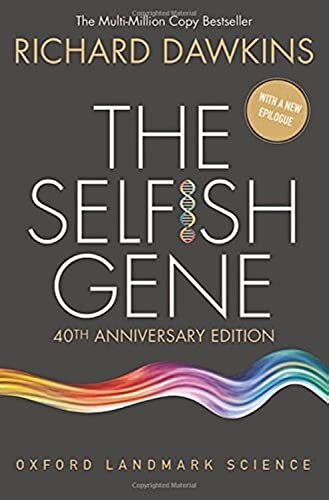
This is one of those remarkable books that changes how you see the world. Dawkins has a gift for taking deeply technical and complicated ideas and explaining them, through analogies and metaphors, in a way that anyone can understand. And once you’ve wrapped your mind around some of these ideas, you are changed forever. Here are just a few of my favorite mind-blowing concepts from this book:
Genes drive life
Instead of looking at the world through the eyes of an individual or a group of individuals, Dawkins shows you how just about everything we know about life can be explained solely through the perspective of a gene.
- What’s remarkable about this is that the gene has no will, no desires, no consciousness.
- The only thing it does is replicate itself.
- Replication is not perfect, so new genes or new combinations of genes will appear from time to time.
- The ones that just happen to fit the world better will live on and the ones that don’t will die.
- From this simple, purely mechanical rule arises all the complexity and intricacy of life—no intelligence or higher power is necessary.
- In a sense, genes are immortal, and our bodies are just vessels the genes create to replicate themselves.
Genes are selfish
- Since only genes that happen to have the right properties for replicating will live on, genes become inherently “selfish”.
- It’s not that the gene is conscious or has “desires”—no more than a rock rolling down a hill is conscious or has a “desire” to be at the bottom of the hill—but the properties that allow a gene to replicate most successfully can be described as being selfish because they exist solely to increase the chances that gene replicates.
Even selfish genes can still behave altruistically
What is fascinating about the selfish gene theory is that you still often get outwardly altruistic behavior as a result. That is, even in a system where all actors are behaving 100% selfishly, depending on the rules of the system, the end result can still be described as altruistic.
- For example, a gene will always “selfishly” program a body to act in a way that increases the chance of the gene being replicated.
- But if there is a copy of that same gene in other bodies, such as your close family members, then part of that programming may be to sacrifice yourself if more than, say, 2 family members are in danger, as the gene has a higher likelihood of replicating if more family members survive.
- So while the gene’s behavior is still purely selfish, the outward result is an animal behaving in a way that seems altruistic.
This is reminiscent of Adam Smith’s invisible hand of capitalism.
- It seems that selfish actors, in the proper system, can sometimes produce a result that is beneficial to all.
- But in a different system, such as that described by the prisoners’ dilemma and tragedy of the commons, you get a result that is detrimental to all.
- What is the key factor that leads to one outcome or the other?
The book spends a lot of time discussing ant colonies as an example of how selfish genes can power communal or altruistic behavior.
- For example, did you know that ants are farmers?
- They grow fungus plants, planting them, feeding them, pruning them, and fighting off pests.
- They even raise cattle; that is, they take care of aphids, protecting them and raising their young, in exchange for being able to “milk” the aphid.
- It also turns out that the queen in an ant colony is closer to being cattle than a ruler.
- The workers have all the control and essentially “farm” her to spread the genes they all share.
Genes program their host
- Genes don’t directly control the body they inhabit—they are not conscious, after all—but merely “program” that body in advance to do things by synthesizing specific proteins.
- From this perspective, genes can also “program” things outside the body.
- A parasite, for example, has genes that affect the body of its host.
- If the interest of the parasite and host coincide (that is, they replicate via the same mechanism), they eventually merge into one being.
- If not, the parasite eventually kills the host.
- In a sense, all our separate genes are like a bunch of parasites working together.
- For example, the mitochondria were most likely parasitic bacteria that, at some point in the past, became part of us and our DNA.
You started as one cell
- Right now, as you read these words, you are composed of trillions of cells.
- But you started out as just one.
- That one cell divided again and again, copying its genes into the trillions of cells that are now “you”.
- It’s one thing to read about cells on a petri dish, but a whole different thing to look at your own hands and marvel at how you came to be.
Genes are one type of replicator
Genes are the best known replicator, but there are others. For example, Dawkins coined the term “meme” for an idea that replicates itself from one mind to another. At first, a meme may seem to be in a totally different category than a gene, but it is just as valid of a replicator, as memes:
- Follow the same laws of natural selection (some ideas survive better than others).
- Replicate themselves by traveling in bodies (the same meme is encoded, physically, in the minds of many humans).
- Occasionally mutate (ideas are not perfectly copied).
Quotes
Of course, my own rephrasing of the book pales in comparison to the original, so I leave you with some of my favorite quotes:
Intelligent life on a planet comes of age when it first works out the reason for its own existence.
Be warned that if you wish, as I do, to build a society in which individuals cooperate generously and unselfishly towards a common good, you can expect little help from biological nature. Let us try to teach generosity and altruism, because we are born selfish.
Darwin’s theory of evolution by natural selection is satisfying because it shows us a way in which simplicity could change into complexity, how unordered atoms could group themselves into ever more complex patterns until they ended up manufacturing people.
An octopus is nothing like a mouse, and both are quite different from an oak tree. Yet in their fundamental chemistry they are rather uniform, and, in particular, the replicators that they bear, the genes, are basically the same kind of molecule in all of us—from bacteria to elephants. We are all survival machines for the same kind of replicator—molecules called DNA—but there are many different ways of making a living in the world, and the replicators have built a vast range of machines to exploit them. A monkey is a machine that preserves genes up trees, a fish is a machine that preserves genes in the water; there is even a small worm that preserves genes in German beer mats. DNA works in mysterious ways.
Genes have no foresight. They do not plan ahead. Genes just are, some genes more so than others, and that is all there is to it
Suppose it is your chromosome number 8a, inherited from your father. It was created inside one of your father’s testicles, shortly before you were conceived. It had never existed before in the whole history of the world. It was created by the meiotic shuffling process, forged by the coming together of pieces of chromosome from your paternal grandmother and your paternal grandfather. It was placed inside one particular sperm, and it was unique. The sperm was one of several millions, a vast armada of tiny vessels, and together they sailed into your mother. This particular sperm (unless you are a non-identical twin) was the only one of the flotilla which found harbour in one of your mother’s eggs—that is why you exist.
Another aspect of the particulateness of the gene is that it does not grow senile; it is no more likely to die when it is a million years old than when it is only a hundred. It leaps from body to body down the generations, manipulating body after body in its own way and for its own ends, abandoning a succession of mortal bodies before they sink in senility and death.
The genes are the immortals, or rather, they are defined as genetic entities that come close to deserving the title. We, the individual survival machines in the world, can expect to live a few more decades. But the genes in the world have an expectation of life that must be measured not in decades but in thousands and millions of years.
Perhaps consciousness arises when the brain’s simulation of the world becomes so complete that it must include a model of itself.
The genes are master programmers, and they are programming for their lives. They are judged according to the success of their programs in coping with all the hazards that life throws at their survival machines, and the judge is the ruthless judge of the court of survival.
Is there anything that must be true of all life, wherever it is found, and whatever the basis of its chemistry? If forms of life exist whose chemistry is based on silicon rather than carbon, or ammonia rather than water, if creatures are discovered that boil to death at ‚àí100 degrees centigrade, if a form of life is found that is not based on chemistry at all but on electronic reverberating circuits, will there still be any general principle that is true of all life? Obviously I do not know but, if I had to bet, I would put my money on one fundamental principle. This is the law that all life evolves by the differential survival of replicating entities. The gene, the DNA molecule, happens to be the replicating entity that prevails on our own planet. There may be others.
When we die there are two things we can leave behind us: genes and memes. We were built as gene machines, created to pass on our genes. But that aspect of us will be forgotten in three generations. Your child, even your grandchild, may bear a resemblance to you, perhaps in facial features, in a talent for music, in the colour of her hair. But as each generation passes, the contribution of your genes is halved. It does not take long to reach negligible proportions. Our genes may be immortal but the collection of genes that is any one of us is bound to crumble away. Elizabeth II is a direct descendant of William the Conqueror. Yet it is quite probable that she bears not a single one of the old king’s genes. We should not seek immortality in reproduction. But if you contribute to the world’s culture, if you have a good idea, compose a tune, invent a sparking plug, write a poem, it may live on, intact, long after your genes have dissolved in the common pool. Socrates may or may not have a gene or two alive in the world today, as G. C. Williams has remarked, but who cares? The meme-complexes of Socrates, Leonardo, Copernicus, and Marconi are still going strong.
We have the power to defy the selfish genes of our birth and, if necessary, the selfish memes of our indoctrination. We can even discuss ways of deliberately cultivating and nurturing pure, disinterested altruism—something that has no place in nature, something that has never existed before in the whole history of the world. We are built as gene machines and cultured as meme machines, but we have the power to turn against our creators. We, alone on earth, can rebel against the tyranny of the selfish replicators.
The fundamental unit, the prime mover of all life, is the replicator. A replicator is anything in the universe of which copies are made.