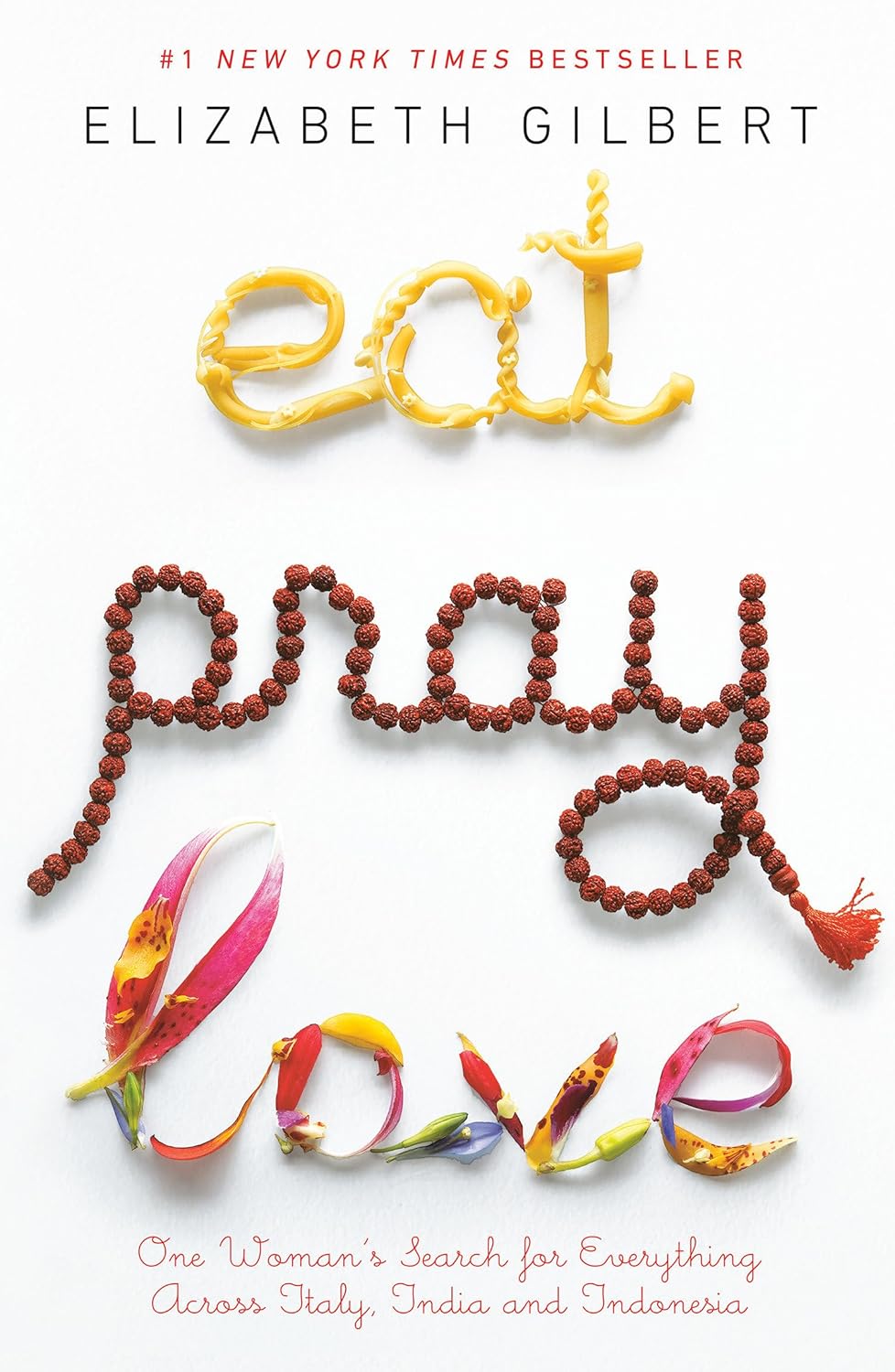
This is Elizabeth Gilbert’s memoir, where she describes going through a messy divorce and midlife crisis, and deciding to turn her life around by spending a year traveling. She spends about 1/3rd of her time in Italy (“eat”), 1/3rd of her time in India (“pray”), and 1/3rd of her time in Bali (“love”). It’s well-written, and some parts are charming and moving, but I’m probably not the target audience (I’m not a 30-something divorced woman looking for a spiritual reawakening), so some parts didn’t really work for me.
The first part of the book, where Elizabeth is eating her way through Italy, was great. I lived in Italy for about a year, and I can completely relate to her descriptions of Italian culture, the art, the architecture, and, of course, the food. Oh man, the parts about the food (especially Naples pizza) made me hungry.
The second part of the book, where Elizabeth spends 4 months in an ashram in India working with a guru and learning to meditate, was not for me. The religious and spiritual stuff doesn’t resonate with me at all, and the whole thing felt a bit absurd. I could only chuckle at Elizabeth’s excitement to work with a guru, only to find the guru would not be in the ashram during her entire visit, but away doing business in some other city. Elizabeth rationalizes this as somehow being better, but like so much else about gurus and religious leaders, it felt like a scam. More generally, the whole seeking-enlightenment-through-meditation thing feels like a scam. Not meditation itself, which can be plenty useful, but the laborious descriptions of how she became one with god and the universe. How egotistical (or high) do you have to be to believe you had some sort of enlightened, god-like experience?
The third part of the book, where Elizabeth goes to Bali, and spends part of her time with a local medicine man, and part of her time falling in love with a Brazilian guy she met there, was a bit better. I knew nothing about Bali, so learning about its history and culture was fascinating. For example, apparently, there are only four first-names in Bali, which translate to first, second, third, and fourth, based on your birth order. So it would be like people in America being named “First of the Smiths” or “Third of the Johnsons.” Of course, everyone then gets a nickname, so you might be “First of the Smiths who owns a convenience store.”
Overall, the book was hit-or-miss. Some parts were genuinely funny or fascinating or moving. Other parts felt fake. In particular, some of the plot points and dialogs felt like they were written for TV, such as meeting a cowboy-hat wearing guy from Texas named Richard at the ashram, and all the sage country-boy advice he gives her. It’s not necessarily that she’s lying, but some of the events and discussions felt like they were exaggerated or editorialized to make for more entertaining reading. Thinking back at the book a few days later, I mostly enjoyed having read it, though I must admit that much of it is already fading.
Quotes
I’ve saved a few of my favorite quotes and ideas from the book:
Every city has a word
Every city has a single word that defines it, that identifies most people who live there. If you could read people’s thoughts as they were passing you on the streets of any given place, you would discover that most of them are thinking the same thought. Whatever that majority thought might be - that is the word of the city. And if your personal word does not match the word of the city, then you don’t really belong there.
The book goes on to give a few examples of words for various cities:
- Rome: sex
- NYC: achieve
- LA: succeed
- Stockholm: conform
Searching for contentment is a gift to the world
As I focus on Diligent Joy, I also keep remembering a simple idea my friend Darcey told me once—that all the sorrow and trouble of this world is caused by unhappy people. Not only in the big global Hitler-‘n’-Stalin picture, but also on the smallest personal level. Even in my own life, I can see exactly where my episodes of unhappiness have brought suffering or distress or (at the very least) inconvenience to those around me. The search for contentment is, therefore, not merely a self-preserving and self-benefiting act, but also a generous gift to the world. Clearing out all your misery gets you out of the way. You cease being an obstacle, not only to yourself but to anyone else. Only then are you free to serve and enjoy other people.
The oak tree creates the very acorn from which it was born
My thoughts turn to something I read once, something the Zen Buddhists believe. They say that an oak tree is brought into creation by two forces at the same time. Obviously, there is the acorn from it all begins, the seed which holds all the promise and potenial, which grows into the tree. Everybody can see that. But only a few can recognize that there is another force operating here as well-the future tree itself, which wants so badly to exist that it pulls the acorn into being, drawing the seedling forth with longing out of the void, guiding the evolution from nothingness to maturity. In this respect, say the Zens, it is the oak tree that creates the very acorn from which it was born.
I think about the woman I have become lately, about the life that I am now living, and about how much I always wanted to be this person and live this life, liberated from the farce of pretending to be anyone other than myself. I think of everything I endured before getting here and wonder if it was me—I mean, this happy and balanced me, who is now dozing on the deck of this small Indonesian fishing boat—who pulled the other, younger, more confused and more struggling me forward during all those hard years. The younger me was the acorn full of potential, but it was the older me, the already-existent oak, who was saying the whole time: “Yes-grow! Change! Evolve! Come and meet me here, where I already exist in wholeness and maturity! I need you to grow into me!” And maybe it was this present and fully actualized me who was hovering four years ago over that young married sobbing girl on the bathroom floor, and maybe it was this me who whispered lovingly into that desperate girl’s ear, “Go back to bed, Liz…” Knowing already that everything would be OK, that everything would eventually bring us together here. Right here, right to this moment. Where I was always waiting in peace and contentment, always waiting for her to arrive and join me.
Choosing your thoughts
I can choose my words and the tone of voice in which I speak to others. And most of all, I can choose my thoughts.
This last concept is a radically new idea for me. Richard from Texas brought it to my attention recently, when I was complaining about my inability to stop brooding. He said, “Groceries, you need to learn how to select your thoughts just the same way you select what clothes you’re gonna wear every day. This is a power you can cultivate. If you want to control things in your life so bad, work on the mind. That’s the only thing you should be trying to control. Drop everything else but that. Because if you can’t learn to master your thinking, you’re in deep trouble forever.”
On first glance, this seems a nearly impossible task. Control your thoughts? Instead of the other way around? But imagine if you could? This is not about repression or denial. Repression and denial set up elaborate games to pretend that negative thoughts and feelings are not occurring. What Richard is talking about is instead admitting to the existence of negative thoughts, understanding where they came from and why they arrived, and then-with great forgiveness and fortitude—dismissing them. This is a practice that fits hand-in-glove with any psychological work you do during therapy. You can use the shrink’s office to understand why you have these destructive thoughts in the first place; you can use spiritual exercises to help overcome them. It’s a sacrifice to let them go, of course. It’s a loss of old habits, comforting old grudges and familiar vignettes.