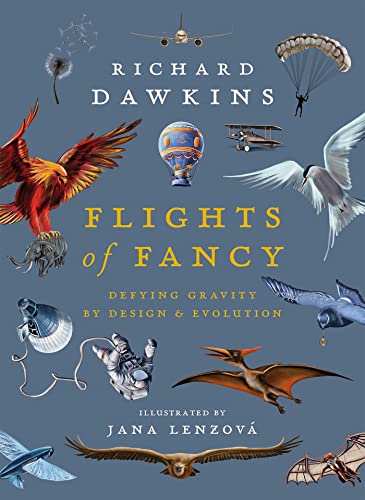
A lovely book on flight, with beautiful illustrations on each page by Jana Lenzová, that covers topics such as how animals evolved flight, the costs and benefits of flying, the physics of flying, and the different mechanisms for flying (wings, lighter-than-air, engines). The book starts a bit slow, with language that feels like it’s intended for children, but then it picks up pace, and is full of stories and illustrations of animals and nature and evolution that fill you with a sense of wonder, no matter what age you are.
For example, there’s a delightful section that talks about the evolutionary arms race that resulted in the “dogfights” between moths and bats. Bats evolved a sort of sonar to help them find moths (even in the dark). In response, moths developed ears that could hear the ultra-high pitch of bat sonar sounds, and as soon as a moth hears those sounds, they start taking evasive maneuvers (in fact, this is probably why moths have ears at all). Not to be outdone, bats evolved faster reflexes and better flying skills. Some moths, in turn, developed fur that absorb the bat sounds, making them harder to detect; other moths developed tiny forked scales that resonate with bat sounds in such a way that they “disappear from the bat’s radar,” a bit like a stealth bomber; and still other moths can make their own ultrasonic noises to “jam” the bat’s radar. How extraordinary is that?
This book also spends a lot of time answering common questions about how flight could’ve evolved. For example, answering the typical challenge from creationists of “what good is half a wing?” It turns out half a wing can actually be very good, compared to no wings at all! For example, flying squirrels, which have flaps, rather than wings, are able to “glide” from branch to branch, covering distances far greater than squirrels without “half a wing.” Likewise, flying fish use their partial wings to evade predators. It’s a nice, gentle intro to a few topics related to evolution, though if that’s your primary interest, you’re better off with Dawkins’ The Blind Watchmaker.
The parts on the mechanics and physics of flying were moderately interesting, though to keep the book accessible to audiences of all ages, Dawkins intentionally avoids any math or highly technical explanations, so those discussions feel a bit simplified. That said, I thoroughly enjoyed the part discussing the physics of how big wings would have to be to allow a human to fly (not to mention the massive breast muscles to power them, and breastbone keels to attach those muscles), including a wonderful edit of Da Vinci’s The Annunciation showing the angel Gabriel with more realistic wings (which comically bust out of the frame).
Overall, it’s a simple, but enjoyable, and at times, delightful read. If you are interested in nature, biology, evolution, birds, or flight, the hard-cover is well-worth it.